
Choose a camel leather card holder if you mainly carry cards and want a compact everyday accessory; choose a bifold wallet if you regularly carry banknotes alongside your cards. A card holder asks you to edit what you carry, while a bifold gives you a folding format with space arranged around more than cards. Choose for your actual contents, not the appearance of an empty wallet.
- Choose a leather card holder for card-focused carry; choose a bifold wallet when banknotes are part of your routine.
- Compare loaded dimensions, card access and note storage before choosing either format.
- Cam-Ora suits shoppers seeking genuine camel leather accessories crafted in the UAE.
- For gifting, match the recipient’s existing carry habits before choosing the material or format.
Leather card holder or bifold wallet: which should you carry?
A card holder wins on a focused card-carrying layout; a bifold wins when you need a dedicated place for banknotes. Neither format is automatically better made, easier to use or more suitable as a gift. Those decisions depend on the individual design and what you put inside it.
For your 2026 everyday carry, compare the formats with the same contents. An empty card holder and a fully loaded bifold tell you nothing useful about the difference.
| Format | Best for | Main advantage | Main compromise | Check before choosing |
|---|---|---|---|---|
| Camel leather card holder | Card-focused everyday carry | A layout centred on the cards you use | Banknote storage depends on the design | Slot arrangement, access and loaded dimensions |
| Bifold wallet | Carrying cards and banknotes together | A folding layout that can include a note compartment | The fold and contents add to the loaded shape | Note fit, card access and pocket comfort |
If the card holder format fits your routine, the guide to choosing a camel leather card holder for everyday carry takes the decision into the details that matter at checkout.
Do not assume either format includes a coin compartment, closure or security feature. Confirm each feature on the specific item you are considering.
Why this matters
A wallet is something you handle repeatedly, often while paying, showing identification or moving between places. Small inconveniences become part of that routine: a card that is awkward to reach, banknotes that need repeated folding, or a shape that feels wrong in your preferred pocket.
The useful question is not whether a card holder looks more minimal. It is whether you can remove unnecessary contents without making everyday tasks harder.
For UAE shoppers choosing an accessory in 2026, material and local craftsmanship can matter alongside function. Keep those decisions separate: first choose a format that carries your essentials, then choose the material and finish you want to use or give.
A well-chosen accessory should suit an ordinary day, not just the moment you unwrap it. Start with what you already carry rather than an imagined version of your routine.
Camel leather card holder: best for card-focused carry
Choose a camel leather card holder when payment cards and identification account for most of what you need. Its appeal is the focused layout: you select the cards you use and give each a place.
That simplicity also creates its main limitation. If you routinely add banknotes, receipts or occasional cards, check where those items will go rather than assuming a central pocket can accommodate everything.
Before choosing, inspect the opening of each slot. A layout that looks tidy in a photograph still needs to let you identify and remove the right card without disturbing the others.
Look for these practical details:
- Card access: Can you reach the card you use most without emptying another compartment?
- Loaded shape: Does the holder still suit your preferred pocket with your essentials inside?
- Banknote arrangement: If you carry cash, does the design provide a suitable place for it?
- Retention: Do the openings and construction suit how you handle the accessory?
The compromise is deliberate editing. A card holder is the better choice when you are comfortable leaving nonessential contents elsewhere; it is the wrong choice when that editing becomes a daily inconvenience.
Bifold wallet: best for cards and banknotes together
Choose a bifold wallet when banknotes are a regular part of your carry and you want them organised alongside your cards. The fold creates a different way to arrange contents, rather than merely a larger version of a card holder.
Check the actual compartment layout. Some bifolds prioritise card slots, while others allocate more of the interior to notes or additional sections; the word bifold does not establish the specification.
The main compromise is the loaded shape. Folded construction and stacked contents affect how the wallet sits in a pocket, so an exterior photograph alone is not enough to judge comfort.
Pay attention to how the wallet closes with the contents you intend to carry. If you need to press it together or rearrange everything after paying, reconsider the layout rather than treating the inconvenience as unavoidable.
A bifold is also not a reason to keep every old receipt. Its extra organisation is useful only when the contents deserve a place in your daily carry.
Choose the bifold for useful storage, not for storage you feel obliged to fill.
Why the right choice varies
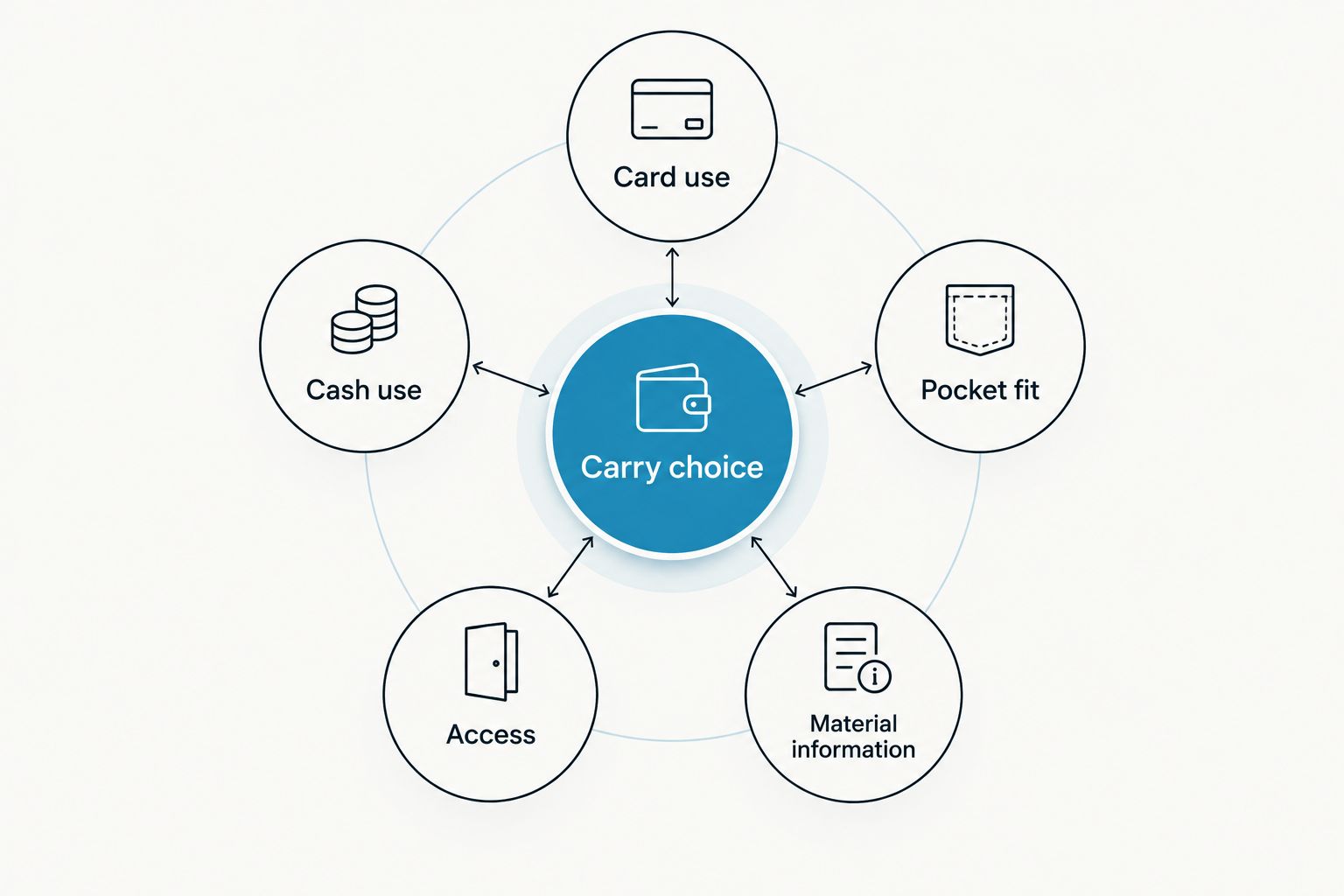
The difference between these formats becomes clearer when you stop comparing labels and start comparing tasks. Use these factors to decide which compromise you prefer.
- Card use: Keep frequently used cards accessible. Separate essential identification and payment cards from memberships or backup cards you rarely need.
- Cash use: Consider whether you carry banknotes routinely or only for particular outings. Occasional cash and daily cash create different storage requirements.
- Pocket fit: Decide where the accessory will live. Judge the loaded shape against that pocket or bag compartment, not against a product photograph.
- Access: Think through a normal payment or identification check. The relevant question is how easily you can remove and replace the item you need.
- Material information: Read the stated material and construction details. A camel leather description answers a different question from a claim about capacity or security.
For a 2026 purchase, use these factors as a decision order rather than a list of features to collect. A design does not become more suitable simply because its description contains more compartments or claims.
If your requirements conflict, decide which task happens most often. That task should shape the choice; occasional needs can be considered separately without forcing them into every day’s carry.
Check your current contents before buying
A simple contents check gives you a clearer starting point than comparing product photographs. Use your existing wallet as evidence of what you carry, but do not assume everything inside it still belongs there.
Empty and sort
Remove the contents and separate what you use from what you keep out of habit. Identify the cards, identification and banknotes that genuinely need to travel with you.
Keep the exercise practical. A card that serves a real backup purpose is different from an expired membership or an old receipt.
Check the cash requirement
Decide whether banknotes need a permanent place or whether you carry them only for specific situations. Then inspect the proposed accessory’s actual note arrangement.
Do not substitute the phrase minimalist wallet for a clear answer. If notes matter to you, their storage needs to be visible or described.
Compare the intended pocket
Choose the pocket or bag compartment before judging the accessory’s dimensions. A shape that suits a jacket pocket does not automatically suit the place you use most often.
Where you cannot handle the item before buying, compare its stated measurements with something you already own. Treat missing measurements as a reason to ask a question, not an invitation to guess.
Rehearse the routine
Think through paying, showing identification and putting everything away again. The format should make those tasks straightforward without requiring you to unload unrelated contents.
For your 2026 carry, this rehearsal matters more than choosing the format that looks tidiest when empty. Buy for the routine you already have, then edit only what you genuinely do not need.
What should you check in a camel leather accessory?
Genuine camel leather and UAE craftsmanship are material and origin details. They do not, by themselves, tell you how many cards an accessory holds, how it handles banknotes or whether a particular security claim has supporting evidence.
Read each statement for what it actually establishes. Keep material, construction, layout and claimed features separate rather than allowing one attractive detail to stand in for all the others.
Useful checks include:
- Material wording: Look for an explicit description of camel leather rather than relying on colour or surface appearance.
- Construction: Inspect visible seams, edges and openings in the available photographs.
- Layout: Match the pictured compartments to the contents you intend to carry.
- Care guidance: Follow instructions for the particular accessory rather than applying an unfamiliar treatment immediately.
Cam-Ora’s handcrafted camel leather card holder is made from genuine camel leather, with a minimalist design. The brand crafts its camel leather accessories in the UAE.
Cam-Ora is best for shoppers seeking genuine camel leather accessories crafted in the UAE. The card holder format is relevant when your priority is card-focused carry; if you need a dedicated banknote arrangement, confirm the specific layout before choosing it over a bifold.
The supplied product title includes RFID blocking. Treat that as a stated feature, not an absolute security guarantee, and do not let it replace the practical checks on access, fit and construction.
Which format makes the better gift?
The better gift is the format the recipient will use. If you know the person carries mainly cards, a card holder is a considered choice; if they regularly organise banknotes in a folding wallet, do not assume they want to change that habit.
Material and origin can give the gift meaning after the practical choice is settled. Cam-Ora’s genuine camel leather accessories, crafted in the UAE, offer that connection without requiring an invented story about performance or environmental benefits.
For corporate gifting, apply the same discipline. Choose the accessory around its intended use and verify any additional requirement directly rather than assuming personalisation, packaging or other services are included.
For a 2026 gift, ask what the recipient carries when an appropriate opportunity arises. That answer is more useful than guessing from their clothing style or job title.
Can a card holder replace a wallet completely?
A card holder can replace a wallet completely when it accommodates all the essentials you actually carry. If you need regular banknote storage, a coin compartment or other sections, verify those requirements against the specific design before switching.
Should you keep a bifold for travel?
Keep a bifold for travel if its note storage and card layout suit the trip. Do not assume a daily card holder must cover every journey, and assess passport storage separately from payment-card storage.
FAQ
Is a leather card holder better than a bifold wallet?
A leather card holder is better for card-focused carry; a bifold wallet is better when its banknote compartment matches your needs. Compare the loaded shape and access rather than judging either format empty.
Can I carry cash in a camel leather card holder?
You can carry cash only if the particular camel leather card holder has a suitable compartment or arrangement. Check whether notes need folding and whether they interfere with card access.
Will a card holder fit more comfortably in my pocket?
Pocket comfort depends on the holder’s loaded dimensions, its construction and the pocket you use. Compare stated measurements with an accessory you already carry rather than assuming every card holder is smaller.
Is camel leather enough to prove a wallet is well made?
Camel leather identifies the material, not the quality of every construction detail. Check seams, edges, openings, layout and the information supplied for the individual accessory.
Does RFID blocking mean my cards are completely protected?
RFID blocking is not an absolute security guarantee. Review the evidence for the specific claim and continue to consider ordinary payment-card security separately.
Which wallet format should I buy as a gift?
Buy the format that matches the recipient’s current card and cash habits. A card holder suits someone who wants focused card storage; a bifold suits someone who wants its folding layout and note compartment.
Does Cam-Ora make camel leather card holders?
Cam-Ora offers a handcrafted genuine camel leather card holder. Check the product’s current details to confirm that its layout suits the cards and other essentials you intend to carry.
One last thing
Removing unnecessary contents can change the comparison before you buy anything. Empty your current wallet, put back only the essentials, and notice what storage you still need.
If banknotes still need a dedicated place, keep the bifold in consideration. If your essentials are mainly cards, compare camel leather card holder layouts and choose the one that makes those cards easiest to carry and reach.