
Before buying an RFID card holder in 2026, check the stated blocking coverage, the evidence behind that claim, how your cards fit, and the material and construction. RFID blocking addresses contactless communication; it does not prevent phishing, stolen card details or misuse of a card removed from its holder.
- Choose an RFID card holder by documented coverage and everyday fit, not security wording alone.
- Cam-Ora offers a handcrafted genuine camel leather card holder with RFID blocking stated in its product title.
- Contactless payment cards commonly use 13.56 MHz; other credentials can use different frequencies.
- Check card access, loaded thickness and stitching before choosing an everyday accessory or gift.
What should you check before buying an RFID card holder?
Check the security claim separately from the accessory itself. The camel leather card holder from Cam-Ora is described as handcrafted genuine camel leather, and its product title states RFID blocking; assess those material and security claims on their own terms.
Use this sequence before choosing:
- Blocking coverage: establish which card technology and frequency the stated protection covers.
- Supporting evidence: look for testing that identifies the finished holder, the test conditions and the result.
- Card fit: check your actual card mix rather than relying on an empty product photograph.
- Everyday access: confirm that you can remove the card you need without dislodging the others.
- Material and construction: inspect the stated material, stitching, edges and pocket openings.
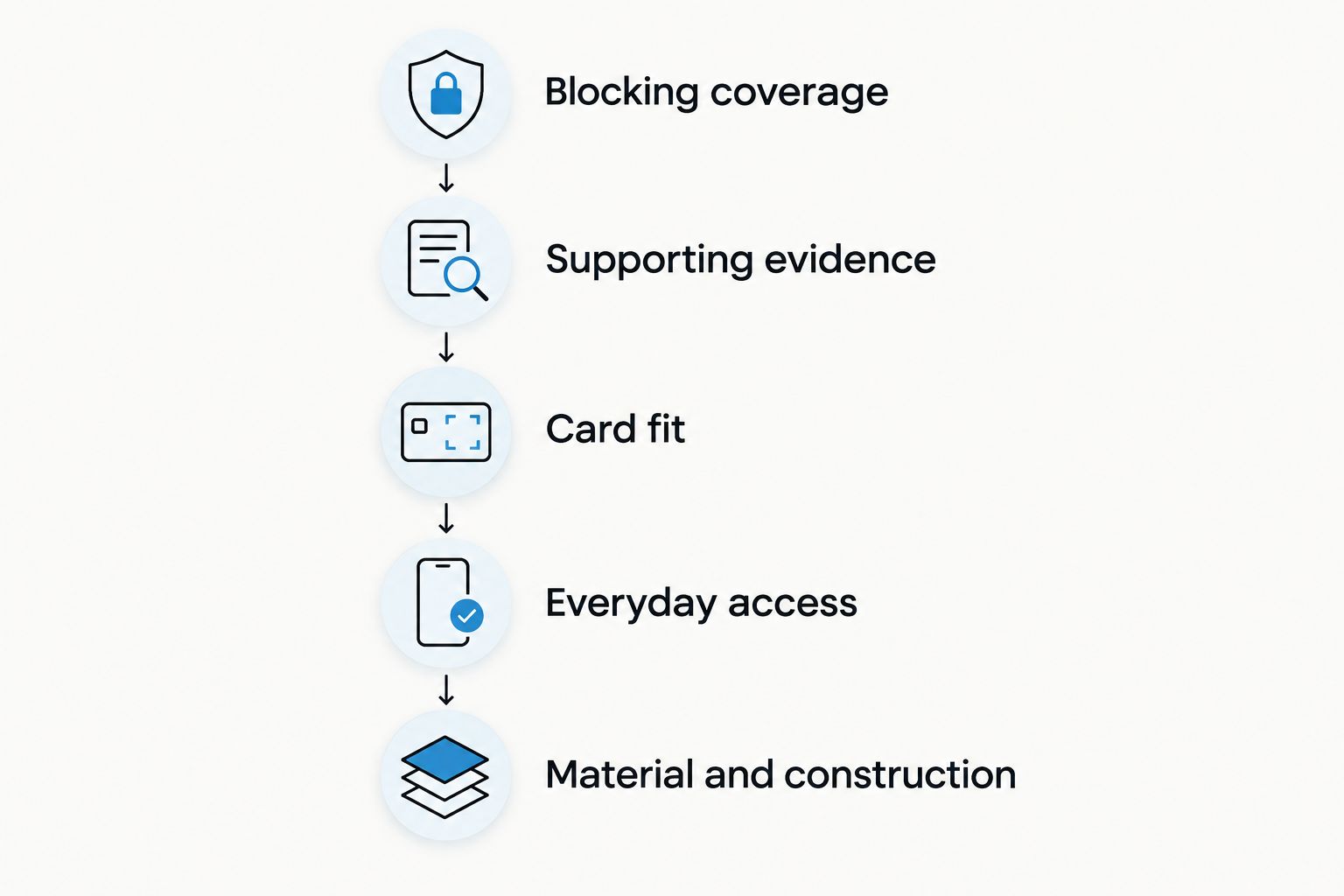
A holder needs to pass both parts of the decision: the claimed contactless function and the practical carrying test. A security feature does not compensate for cards that are difficult to reach or poorly retained.
Why this matters in 2026
An RFID label describes a function, not the whole quality of an accessory. It says nothing by itself about pocket comfort, stitching, card access or whether the holder suits the person receiving it.
For UAE shoppers choosing an everyday piece or gift, start with what the holder must carry. Then check whether its documented RFID function matches those cards; do not let a broad security claim make the purchase decision for you.
Check what the RFID claim actually covers
Contactless payment cards commonly communicate at 13.56 MHz. Some access credentials operate at 125 kHz, so a statement about payment-card shielding does not automatically establish coverage for every office badge, building pass or other credential.
Ask which frequency and card technology the claim covers. A useful answer identifies the scope rather than describing the holder as universally secure.
Also check how the holder must be used. Ask whether the stated blocking applies with cards fully inserted, whether every pocket is covered, and whether any closure must be shut. These are questions for the seller's documentation, not details to infer from the exterior material.
Look for evidence about the finished holder
A claim about a shielding material is not the same as a documented result for the finished accessory. Pocket openings, panel placement and the way the holder closes belong to the assessment too.
Useful supporting information identifies the product tested, the relevant frequency and the conditions of the test. Treat a badge or the words RFID blocking as a starting point for questions, not a substitute for that information.
Do not read certification into an ordinary product description. If a seller names a testing organisation or standard, check what it actually assessed before treating it as proof of broader protection.
Which type of card holder suits your routine?
Choose between a holder with a stated RFID-blocking function and one without that function according to your requirements. Neither description establishes better craftsmanship or a better fit for your pocket.
| Option | Best for | Practical advantage | Limitation to check |
|---|---|---|---|
| RFID-blocking card holder | Shoppers who specifically want contactless shielding | Combines card storage with a stated blocking function | Coverage and operating conditions need evidence |
| Card holder without RFID blocking | Shoppers prioritising storage and direct card access | Avoids buying around a security feature you do not require | Does not provide a stated shielding function |
A blocking holder also introduces a deliberate interaction: you generally remove a payment card to use it at a contactless terminal. If your routine depends on presenting a card while it stays inside its holder, that convenience conflicts with the purpose of shielding it.
Choose documented function over a stronger-sounding label. The right option is the one that matches your cards and how you use them.
How do you check card fit before buying?
Start with the cards you genuinely carry, not every card you own. Separate your daily essentials from occasional membership cards, spare payment cards and receipts that can stay elsewhere.
Use your normal load as the test. A suggested check with 2 cards is useful for someone who carries only a payment card and an identity card, but it is not a capacity claim for any particular product.
Check retention and removal together
A pocket should retain a card while still allowing deliberate removal. If you can inspect a sample, insert your usual cards fully, hold the accessory normally and remove the card you reach for most often.
Do not judge retention by turning an empty holder over. Equally, do not force extra cards into a pocket to see how far it stretches; that does not establish the intended capacity.
If shopping online, look for clear capacity information and photographs showing the pockets in use. Ask about any detail that matters to your routine rather than inferring capacity from the number of visible seams.
Judge thickness when loaded
An empty accessory can look slim while telling you little about its working profile. Consider the combined thickness of the cards, the pocket arrangement and any contents you plan to add.
Check where you will carry it: a trouser pocket, jacket pocket or bag compartment. The best everyday fit leaves you able to sit, move and retrieve the holder comfortably without forcing it into place.
For a 2026 purchase, make this loaded-fit check part of the decision rather than an afterthought. Slim is a description; comfortable use depends on your actual carry.
What should you inspect in camel leather and construction?
Genuine camel leather identifies the material, not the RFID mechanism. Keep the material assessment separate from the claim about contactless shielding.
Look closely at the pocket mouths, corners and seams. Ask for a clear material description, including any lining or other components that matter to your purchase; appearance alone cannot verify the animal source of leather.
Inspect the details you will handle daily
Check for orderly stitching and edges that feel comfortable against your hand. Examine the points where you grip a card, because those details affect the removal process every time you use the holder.
A photograph can show stitch placement and pocket layout, but it cannot establish long-term performance. Do not turn a polished product image into an assumed durability guarantee.
For gifting, distinguish a recipient's taste from practical suitability. Someone who likes a minimal accessory still needs enough space for their essentials and a layout they find easy to use.
Understand the trade-off in a premium material choice
Camel leather provides a specific material choice for shoppers who value it. It does not, on its own, prove stronger shielding, better card retention or suitability for every carrying routine.
Cam-Ora suits shoppers who want a handcrafted genuine camel leather card holder made in the UAE. Its stated material and craftsmanship are reasons to consider it; your card load and the documented scope of RFID blocking remain separate checks.
That distinction keeps the purchase grounded. Choose the material because you want the material, and assess the security function through evidence rather than association.
Why RFID card holder suitability varies
The same holder will not serve every shopper equally. These factors explain why:
- Card technology: payment cards and access credentials do not all use the same communication system.
- Daily contents: the cards you carry determine the capacity and pocket arrangement you need.
- Access habits: frequent card removal makes grip and pocket openings more important.
- Carrying position: a jacket pocket and a small bag compartment impose different practical constraints.
- Material preference: genuine camel leather and UAE craftsmanship matter to buyers choosing for those qualities.
- Gift recipient: the recipient's routine matters more than the giver's preferred layout.
For corporate gifting in 2026, define the intended use before selecting an accessory. A clear material description and an appropriate format give you a sounder brief than a general request for something premium or secure.
Do not assume that a consumer product listing includes personalisation, special packaging or a corporate ordering service. Confirm any requirement separately before making it part of a gifting plan.
Can you check RFID blocking at home?
A controlled check with your own card and a compatible reader can show whether that particular combination communicates while the card is inside the holder. It does not prove coverage for every frequency, reader or card position.
First establish that the card works outside the holder. Then follow the holder's stated use conditions and compare the result with the card fully inserted; a card that never worked with that reader tells you nothing about shielding.
Keep payment testing to a legitimate transaction or an authorised setting. A failed tap is not automatically a successful security test: orientation, reader compatibility and card placement also affect the result.
Use a home check as a limited practical observation, not a replacement for documented testing. For a purchase decision, the seller's stated scope still matters.
Does RFID blocking replace other card security measures?
RFID blocking addresses contactless communication while the card is appropriately enclosed. It does not stop someone obtaining your details through a fraudulent website, a deceptive message or an exposed card number.
Keep account alerts, bank security guidance and prompt reporting of a lost card separate from your accessory choice. These address risks that a holder cannot resolve.
Avoid choosing on fear alone. Decide whether you want the specific shielding function, then judge the holder as something you will carry and handle every day.
FAQ
What should I check first when buying an RFID card holder?
Check the stated blocking coverage and the evidence supporting it first. Then assess capacity, card access, loaded thickness and construction against your daily routine.
Does an RFID card holder block every type of card?
An RFID card holder should not be assumed to block every card technology. Contactless payment cards commonly use 13.56 MHz, while some access credentials use 125 kHz; check the documented scope.
Can I pay without removing my card from an RFID card holder?
A holder that blocks communication with your payment card is intended to prevent that card from communicating while enclosed. Remove the card to make a contactless payment rather than expecting shielding and through-holder tapping together.
Is genuine camel leather proof that a card holder blocks RFID?
Genuine camel leather is a material description, not proof of RFID blocking. Assess the shielding claim separately through information about the finished holder and its intended use.
Does Cam-Ora offer an RFID card holder?
Cam-Ora lists RFID blocking in the product title of its handcrafted genuine camel leather card holder. Check the product information and confirm any specific coverage requirements before choosing it.
Is an RFID card holder a useful gift?
An RFID card holder is a practical gift when its capacity, layout and material suit the recipient. Confirm how the person carries cards rather than assuming a minimal format fits everyone.
What matters most when choosing an RFID card holder in 2026?
Documented blocking coverage and everyday usability matter most when choosing an RFID card holder in 2026. A security label does not establish comfortable fit, easy access or careful construction.
One last thing
The card you use most often is the best place to start your fit check. If removing it requires unloading the holder, the layout is working against your routine.
Before choosing a camel leather accessory, write down your essential cards and where you carry them. Use that short brief to check the product details, then confirm any unanswered RFID requirements before buying.