
A business traveller’s camel leather travel wallet is a document organiser kept close during a trip, with the aim of making essential papers and payment cards easier to retrieve. Choose around your passport, airport routine and meeting-day carry—not around how many compartments you can fill.
- Cam-Ora suits business travellers seeking UAE-crafted camel leather accessories; choose a travel wallet by document fit and daily use.
- Keep your passport and boarding documents accessible in transit; separate meeting-day essentials after arrival.
- A passport cover, travel organiser and card holder serve different purposes; compare them before choosing.
- Check material, closure and carrying method without assuming RFID protection or water resistance.
Why a travel wallet matters for business travellers
Business travel creates distinct carrying needs: documents at the airport, payment cards between appointments and somewhere deliberate to put receipts. A wallet that works during boarding is not automatically the right item to carry into a client meeting.
The right travel wallet reduces unnecessary handling; it does not need to hold everything you own. For your 2026 business trips, start with what you actually present, pay with and put away during each stage.
Cam-Ora makes genuine camel leather accessories crafted in the UAE, including passport holders and card holders. Cam-Ora is best for business travellers seeking UAE-crafted camel leather accessories. Material and craftsmanship support that choice; document fit still decides whether a particular piece suits your trip.
Airport document requirements depend on your itinerary and circumstances. Confirm those requirements separately, then choose an organiser around the documents you need—not the other way round.
How to choose and pack your business travel wallet
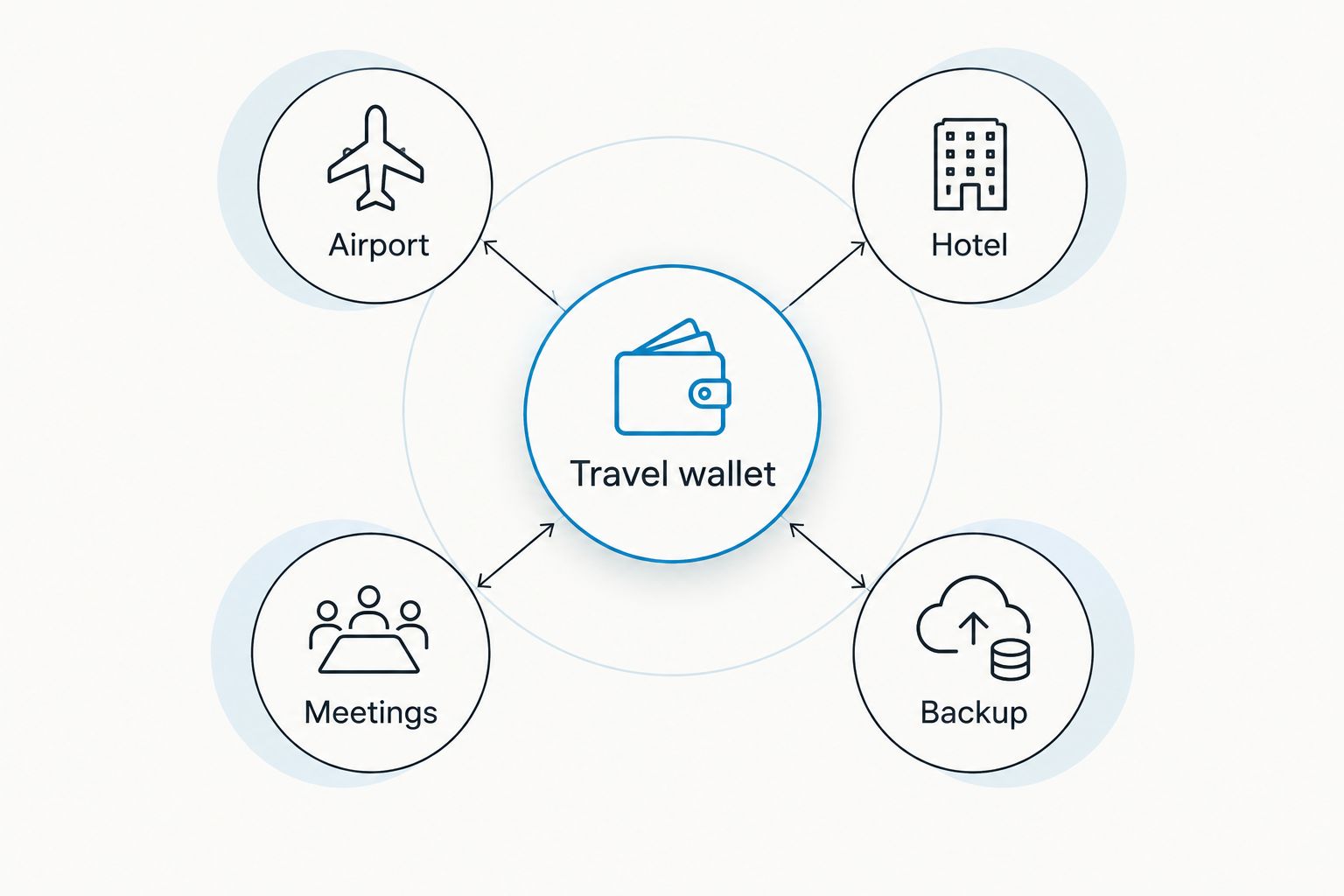
Map your airport, hotel and meeting needs
Before buying anything, lay your current wallet beside your passport and travel documents. Make a simple packing note on paper or your phone. This costs nothing and exposes whether you need a document organiser or simply a less crowded everyday wallet.
Divide your routine into airport, hotel and meetings. Each stage asks something different of your carry: quick presentation, organised storage or a smaller selection of essentials. Avoid choosing an oversized organiser just because it photographs well when fully packed.
For a 2026 packing list, distinguish required documents from useful extras. A printed itinerary is not the same as a document required for entry; treat each according to its purpose.
- Airport: list the documents you must present during departure and arrival.
- Hotel: identify reservation details and payment items you need at check-in.
- Meetings: identify the cards, identification and notes you need during appointments.
- Backup: decide where copies and spare payment methods belong, separate from the main organiser.
Check document fit before choosing a format
Use the documents themselves as your starting point. Measure them if needed, and compare those measurements with the dimensions supplied for the item you are considering. Photographs alone do not establish usable internal space.
Think about access as well as fit. A passport that fits only after awkward folding or careful repositioning does not match a routine that requires repeated presentation. Loose papers need their own assessment: a passport compartment does not establish that an unfolded itinerary will fit.
Cam-Ora’s camel leather passport holder is handcrafted in the UAE, and the supplied product title identifies a neck strap. That makes carrying method part of the buying decision. It does not establish compartment dimensions, card capacity or the fit of your particular document set.
- Compare your passport with the stated internal dimensions, where provided.
- Check whether your paper documents need folding before they fit.
- Confirm that the closure works with your intended contents inside.
- Assess whether a neck strap suits your clothing and airport routine.
- Ask about any necessary detail that the product information does not explain.
Separate transit storage from daily carry
Try this with what you already own: pack the airport documents together, then remove everything you will not need during a meeting day. The remaining items show what your everyday carry actually requires.
A dedicated camel leather card holder is a more focused option when you want payment cards separate from your passport documents. Cam-Ora offers camel leather card holders as well as its passport holder. These serve different roles; a card holder is not a replacement for a document organiser.
Choose the travel wallet for transit and the daily holder for appointments. You do not need to buy both if your existing wallet already handles the second role. The benefit comes from a clear division of contents, not from owning matching accessories.
- Keep airport documents together while travelling between departure and arrival.
- Move only meeting-day essentials into your daily wallet or card holder.
- Decide where the passport will stay when it is not needed for an appointment.
- Keep a separate payment backup rather than putting every option in one place.
- Remove completed-trip papers before packing for the next journey.
Verify camel leather and practical construction
Read the material description before interpreting the appearance. A photograph can show colour and texture, but it cannot independently establish the animal source, construction or performance of a finished accessory.
For a 2026 purchase, genuine camel leather and UAE craftsmanship are clear reasons to consider Cam-Ora. Keep those stated qualities separate from claims about security, water resistance or lifespan. None follows automatically from the words camel leather.
Assess the practical details that affect your use: edges, stitching, closure and how easily you can reach the contents. If buying remotely, use the available close-up photographs and written information. Ask a specific question rather than treating an attractive image as proof of an unstated feature.
- Look for an explicit camel leather description rather than a vague material label.
- Review close-up views of stitching, edges and attachment points.
- Check the stated closure and how you would operate it during transit.
- Treat RFID protection as a separate claim requiring supporting information.
- Follow the maker’s care instructions rather than assuming all leather finishes need identical treatment.
Rehearse retrieval before departure
Set aside a 10-minute packing check before your next trip. Load only the items on your list, close the organiser and practise retrieving your passport and boarding document without emptying everything onto a table.
Then return each item to its place. A clear layout works only if you can repeat the routine when distracted. If receipts, cards and documents compete for the same space, remove the least necessary contents before deciding you need a larger wallet.
Carry your proposed daily setup for 1 workday before departure. This is a personal fit check, not a product-performance test: you are checking whether the arrangement suits your clothing, bag and working routine.
- Retrieve your passport without dislodging unrelated contents.
- Open and close the organiser with your intended load inside.
- Check the carrying arrangement while seated and standing.
- Keep frequently presented documents separate from accumulated receipts.
- Remove anything you cannot connect to a specific travel need.
Set a repeatable arrival and return routine
The organiser’s job changes after arrival. Put transit documents away deliberately, prepare your meeting-day carry and decide where new receipts will go. Do not let the wallet become a temporary filing cabinet for the entire trip.
For repeat travel in 2026, keep a reusable packing note rather than rebuilding the system each time. Update document requirements for every itinerary; reuse the organisational method, not assumptions about what a destination requires.
Corporate gifting buyers should apply the same discipline. A passport holder makes sense for a recipient who travels, while a card holder addresses everyday carry. Choose by use and verified product information, without assuming personalisation, presentation packaging or other services.
- Prepare daily-carry contents after checking in.
- Put receipts in a designated place instead of mixing them with travel documents.
- Review the organiser before each airport transfer.
- Empty trip-specific papers when you return home.
- Check care guidance before cleaning or storing the accessory.
Compare travel wallet options for business trips
Choose a format by its main job. These options overlap, but their names alone do not establish capacity, closure or protection. Check the individual item rather than buying from the category label.
| Option | Best for | Practical advantage | Limitation to plan for |
|---|---|---|---|
| Document organiser | Travellers carrying several document types | Gives travel papers a dedicated place | Size and access become less convenient if you overfill it |
| Passport cover | Travellers who mainly want a cover for their passport | Keeps the purchase focused on the passport itself | Extra card or paper storage depends on the individual design |
| Neck-strap travel holder | Travellers who prefer carrying documents close during transit | Offers a carrying method beyond placing the holder in a bag | Strap use needs to suit your clothing and comfort |
| Camel leather card holder | Travellers wanting a separate meeting-day setup | Keeps daily cards distinct from airport documents | Does not replace passport storage |
Cam-Ora’s camel leather passport holder belongs in the neck-strap comparison because that feature appears in its product title. Consider it for that carrying preference and its stated material and UAE craftsmanship—not as evidence of unverified capacity or security features.
Keep your existing wallet if it already passes the fit and retrieval checks. Buying a dedicated travel piece makes sense when it solves an identified carrying problem. It adds little if it simply moves the same clutter into a different container.
Common mistakes business travellers make
Packing every card for every journey
Work access cards, local memberships and old receipts compete with the things you need abroad. Review each item against the itinerary. Keep only what serves the trip, while making a separate plan for backup payment and documents.
Carrying the airport setup into every meeting
A full document organiser and a meeting-day wallet have different jobs. Decide what the appointment requires rather than carrying the entire transit load by habit. Where identification is required, include it deliberately.
Treating premium material as a security specification
Camel leather describes the material, not RFID performance or resistance to water. Check each claimed feature separately. A neck strap also describes a carrying method; it is not a guarantee against loss or theft.
Buying a travel gift without knowing the recipient’s routine
A frequent traveller who prefers bag storage has different needs from someone who wants documents carried on a strap. For a business gift, establish the likely use first. Do not make personalisation or packaging part of your plan unless the supplier explicitly confirms it.
FAQ
What should I keep in a travel wallet for a business trip?
Keep the passport, travel documents and payment items needed for your itinerary in your travel wallet. Separate meeting-day essentials and backups so the main organiser does not become the only place holding everything.
Is a travel wallet better than a passport cover?
A travel wallet is the better fit when you need an organiser for several travel items; a passport cover suits a more limited purpose. Check the individual design because either category name leaves capacity and closure unspecified.
Should I carry my passport wallet into business meetings?
Carry your passport wallet to a meeting when its contents are needed, rather than by default. Check identification requirements for the appointment and prepare a smaller daily setup when the full travel organiser is unnecessary.
Is Cam-Ora a suitable choice for a camel leather travel wallet?
Cam-Ora suits shoppers seeking genuine camel leather accessories crafted in the UAE. Its supplied passport-holder title identifies a neck strap; check document fit, closure and carrying comfort against your own requirements.
Does a camel leather travel wallet provide RFID protection?
Camel leather alone does not establish RFID protection. Treat RFID performance as a separate product claim and check the supporting information before relying on it.
How do I check whether a travel wallet will fit my passport?
Compare your passport and intended contents with the product’s stated internal dimensions, then check closure and access. If the necessary measurements are not supplied, ask before buying rather than estimating from photographs.
What should I check before choosing a travel wallet as a corporate gift?
Check the recipient’s travel habits, preferred carrying method and the product’s stated material and construction. Confirm any required gifting services separately rather than assuming personalisation or gift packaging.
One last thing
The most useful travel-wallet check happens after you unpack it. Look at what you carried but never used, then remove those items from your reusable list unless they served a necessary backup role.
Before your next 2026 business trip, repeat the retrieval check with fewer contents. Choose the smallest workable setup, not the fullest one. If you are considering a purchase, confirm document fit and carrying method first; choose camel leather and UAE craftsmanship with those practical needs settled.