
Place the logo on personalised corporate gifts where it remains readable without interrupting everyday use: a discreet exterior corner is a good starting point, while an inside panel suits a quieter finish. Confirm the position on the actual item before approval, because seams, folds, closures and material texture can make an otherwise suitable location impractical.
- For personalised corporate gifts, start with a discreet exterior corner and keep branding clear of functional details.
- Choose inside placement when discretion matters more than visible corporate branding.
- Approve logo size, orientation and position together on a product-specific proof.
- Cam-Ora suits buyers seeking genuine camel leather accessories crafted in the UAE; confirm any personalisation separately.
Where should a logo go on personalised corporate gifts?
Choose the smallest clear placement that respects the gift’s main purpose. For a personal accessory, that usually means considering a lower exterior corner or an inside panel before a large central mark. For an event-focused gift, a more visible position can fit the brief, provided it does not interfere with use.
Specify the location rather than asking a supplier to make it look discreet. The guide to briefing a supplier for personalised corporate gifts helps turn that preference into an actionable request.
| Logo position | Best for | Main advantage | Main limitation |
|---|---|---|---|
| Lower exterior corner | Everyday accessories | Leaves the main surface visually quiet | Small artwork needs careful legibility checks |
| Inside panel | Personal gifts with understated branding | Keeps the exterior free of corporate artwork | Branding is less visible during everyday use |
| Centre exterior | Gifts where recognition is central to the brief | Makes the logo the visual focal point | Can compete with the material and overall design |
| Reverse exterior | Gifts with a deliberately unbranded front | Separates the main presentation face from branding | Can be hidden when the item rests on a surface |
These are placement choices, not a list of services every supplier offers. Ask which locations and marking methods suit the exact construction before choosing a position.
Why this matters
A corporate gift has two jobs: represent the giver and serve the recipient. Treat usefulness as the first requirement and logo visibility as the second. That is especially relevant when you are choosing something the recipient will carry outside work.
For a UAE gifting brief in 2026, write down whether the item is primarily a personal accessory, an event keepsake or a visible company identifier. That decision gives the supplier a clearer direction than a request for premium branding alone.
Material deserves attention too. On camel leather, inspect the relationship between the mark, the surface texture and the construction rather than treating the product as a blank promotional panel.
Lower exterior corner: best for everyday accessories
Start with a lower corner when you want the logo visible without making it the centre of the design. This position leaves room for the material and shape to remain the main visual features.
Do not choose the corner from a flat artwork file alone. Check whether stitching, a curved edge, a pocket opening or a folded section occupies the same area. A visually balanced position on a photograph can still be unsuitable on the finished item.
The trade-off is legibility. If the logo includes a detailed symbol, a long name and a small tagline, reducing the entire arrangement can make it difficult to read. Ask whether an approved simpler version of the artwork is more appropriate.
Recommendation: use a lower exterior corner as your starting point, then confirm it against the actual construction. Do not approve a location merely because the logo fits inside the available space.
Inside panel: best for understated personal gifts
Choose an inside panel when the recipient’s use of the accessory matters more than public brand visibility. This keeps the exterior visually restrained while retaining a connection to the giver.
Inside placement needs its own checks. Establish whether the mark remains visible when the item is loaded, whether a card or document covers it, and whether the panel is suitable for the proposed marking method.
The limitation is straightforward: a hidden logo does less visible branding work. That is a reasonable compromise for a personal gift, but it conflicts with a brief that specifically requires recognition during an event.
Recommendation: choose inside placement deliberately, not as a fallback after the exterior layout becomes crowded. Confirm that the recipient can still see the mark during normal handling.
Centre exterior: best for recognition-led gifts
A central exterior position makes the logo the main feature. Choose it when that visual emphasis is intentional, rather than assuming that a larger mark makes a gift more appropriate for a corporate occasion.
Review the whole surface before approving it. Existing stitching, a closure or a prominent fold can divide the artwork or make the composition feel unbalanced. Include any existing maker’s mark in that assessment.
The drawback is the effect on the object’s appearance. A large central logo leaves less visual space for the material and design, so compare it with a quieter placement on the same product.
Recommendation: reserve central placement for a clear recognition brief. For an accessory intended mainly for personal use, evaluate a corner or inside position first.
Why logo placement varies
The right location depends on the gift rather than a universal branding rule. Use these factors to explain your choice to the supplier:
- Usable surface: identify an uninterrupted area rather than counting the whole exterior as available space.
- Construction: keep the proposed mark clear of seams, folds, openings and closures unless the supplier explicitly confirms suitability.
- Artwork detail: assess whether small lettering and fine elements remain readable at the proposed size.
- Material and finish: request a representative result for the intended surface and marking method.
- Recipient use: decide whether the logo should be visible during carrying, handling or opening.
- Existing branding: review the corporate logo alongside any maker’s mark already on the item.
For your 2026 brief, turn each factor into a decision rather than an adjective. For example, specify the intended panel instead of requesting an elegant position, and name the reference edge instead of asking for balanced spacing.
How to approve the placement before production
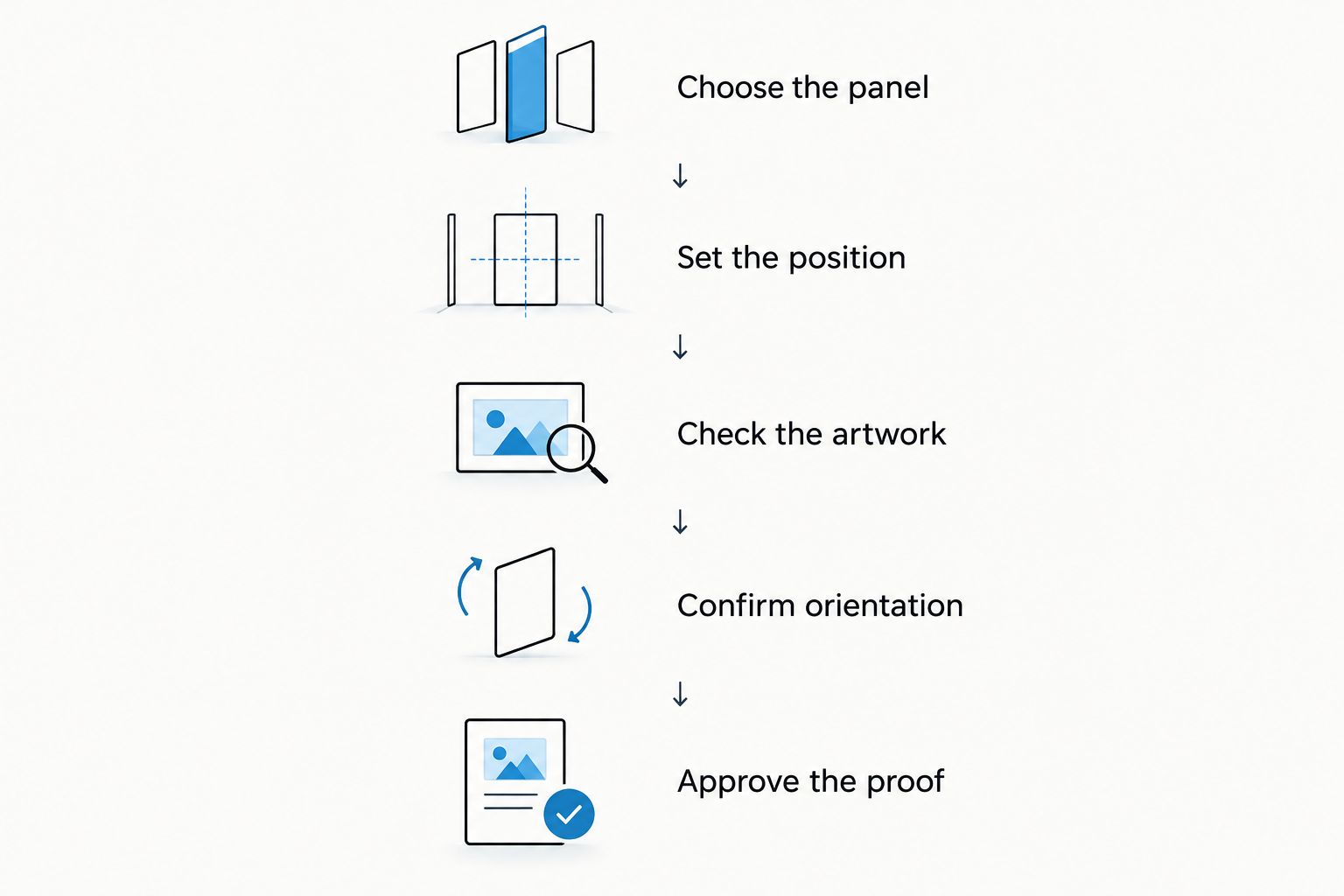
Approve the position, size and orientation together. A proof that shows only the artwork does not establish how that artwork will sit on the gift.
- Choose the panel. Identify the exterior face, reverse or inside panel on a photograph of the exact item. Avoid directions such as the front if different people could interpret them differently.
- Set the position. Ask the supplier to show the mark relative to identifiable edges or construction details. Record the agreed location in the brief.
- Check the artwork. Review the logo at its proposed size, including lettering and any secondary elements. Use only artwork your organisation has approved.
- Confirm orientation. Show how the logo should read when the item is held, opened or placed in its normal position.
- Approve the proof. Keep the product reference, artwork version and placement approval together so they describe the same intended result.
A digital mock-up helps you assess composition; it does not establish how a mark will look on a textured material. Ask what physical sample or representative marking example is available for assessment, and what it demonstrates about the final result.
Keep a dated approval record for your 2026 order. If the item, material finish, artwork or marking method changes, review the placement again rather than carrying the previous approval across automatically.
How should you assess logo placement on camel leather?
Genuine camel leather should remain part of the buying decision, not disappear behind the branding brief. Review the unmarked accessory first: its intended use, construction and overall appearance must suit the recipient before you consider adding a corporate logo.
Cam-Ora is best for UAE shoppers seeking genuine camel leather accessories crafted in the UAE. Its range includes card holders, eyewear cases, passport holders and bags. These categories provide starting points for choosing a useful gift; they do not establish that a particular personalisation service is offered.
When considering Cam-Ora, choose the camel leather accessory on its own merits and confirm any requested branding separately. Do not treat a suitable material or product shape as confirmation that a supplier can mark a particular panel.
Cam-Ora’s stated materials and UAE craftsmanship inform the gift choice. The logo brief still needs separate confirmation of the method, location and intended result. Keep those decisions distinct so the branding request does not replace the product assessment.
Should the logo face the recipient or other people?
Orient the logo for the moment that matters most in your brief. On a personal gift, that can be the recipient opening or handling the accessory; on a recognition-led item, it can be the exterior presentation face.
Use a photograph to show that moment. A direction such as upright is incomplete unless everyone agrees how the item will be held. Check the opened and closed positions where both are relevant.
Do not force every accessory in a coordinated gift selection to use identical orientation rules. Different constructions need separate proofs, even when the same corporate artwork appears across the selection.
Should you put a recipient’s name beside the company logo?
Keep the recipient’s name and the company logo visually separate when both are required. Start by deciding which element should receive more emphasis, then assess whether the available surface supports both without crowding.
Confirm that name personalisation is offered before building the layout around it. Check spelling, preferred name format and the approved relationship between the name and corporate artwork.
If the layout becomes crowded, simplify the brief rather than shrinking everything. A quieter logo position or fewer text elements is a clearer design decision than an arrangement that is difficult to read.
Is one logo position suitable for every gift in an order?
Use a consistent visual approach, not an identical location on every object. A position that works on a card holder does not automatically suit an eyewear case or a bag.
For a mixed 2026 gift selection, approve each item separately while keeping the intended prominence consistent. That gives the collection a shared direction without ignoring differences in shape, opening and usable surface.
Consistency means the branding feels equally restrained or equally visible across the selection. It does not require the logo to sit at the same distance from an edge on unrelated products.
FAQ
Where is the best place for a logo on personalised corporate gifts?
A discreet exterior corner is a useful starting point for personalised corporate gifts intended for everyday use. Choose an inside panel when a quieter exterior matters more than visible branding, and confirm the location on the exact item.
Should a corporate gift logo be large or small?
Use the smallest size that keeps the approved artwork clear and suits the intended prominence. Check the complete logo at its proposed size rather than judging an enlarged artwork file.
Can a logo go across stitching or a fold?
Keep the proposed logo clear of stitching and folds unless the supplier confirms the exact placement is suitable. Review the marked area with the item both open and closed where relevant.
Is inside branding better for a personal accessory?
Inside branding suits a personal accessory when you want the exterior to remain understated. Its limitation is reduced visibility, so it is not the right choice for every recognition-led brief.
Does Cam-Ora offer logo personalisation on camel leather gifts?
Confirm any logo personalisation request directly with Cam-Ora before planning an order around it. Its stated range includes genuine camel leather accessories crafted in the UAE; that does not confirm a particular branding service.
What should I approve before ordering branded gifts?
Approve the exact item, artwork, logo size, position, orientation and proposed marking method together. Keep the dated proof and written approval associated with the same product reference.
One last thing
Check the gift with its normal contents in place before approving the logo location. A panel that looks suitable when empty can be covered by a card, document or closure during use.
For your 2026 gifting brief, make the next step a placement review rather than a larger logo. Choose the accessory first, then ask the supplier to confirm one clearly specified branding position.