
Camel leather identifies the animal the hide comes from; camel-coloured leather identifies a shade, not the animal. To tell them apart when shopping in 2026, look for an explicit camel-hide or genuine camel leather statement in the material description, and do not treat colour, photographs or the word genuine alone as confirmation.
- Camel leather describes hide origin; camel-coloured leather describes colour, not species.
- Cam-Ora makes genuine camel leather accessories crafted in the UAE for everyday use and gifting.
- Check the material description separately from the colour selector and place-of-manufacture statement.
- A photograph, grain pattern or smell cannot establish camel-hide origin on its own.
Why this matters
If you want camel leather, a camel-coloured accessory does not necessarily meet your brief. A colour name tells you how an item looks; it does not establish what the outer material is made from. The distinction matters whether you are buying a card holder for yourself or choosing a gift with a connection to the UAE.
Buy against the material statement, not the shade name. The same discipline applies to other claims in a listing: construction, manufacturing location and practical features need their own descriptions. Use the guide to checking camel leather product claims when assessing the wording behind a purchase.
Camel leather or camel-coloured leather: how can you tell?
Read the material field before the colour field. The clearest wording identifies camel as the hide source and distinguishes the outer material from any lining or other components. A heading that simply says camel leaves the material question unanswered.
| Wording you see | What it establishes | What still needs checking |
|---|---|---|
| Genuine camel leather | An explicit claim that the leather comes from camel hide | Which parts of the accessory use that material |
| Camel-coloured leather | A colour description applied to leather | The animal source of the leather |
| Camel | A label whose meaning depends on context | Whether it describes colour or material |
| Genuine leather, colour: camel | A leather claim and a separate colour choice | Whether the hide comes from camel |
| Camel leather, crafted in the UAE | Separate claims about material and craftsmanship location | Component details and suitability for your use |
These descriptions are not interchangeable. A clear material statement gives you something specific to assess and ask about; an attractive image does not replace it.
A listing can also use both terms correctly. An accessory could be made from camel leather and offered in a camel shade, but each claim needs to stand on its own.
What does genuine camel leather actually tell you?
Genuine camel leather identifies the material as leather made from camel hide. It does not, by itself, describe every aspect of an accessory's construction, finish or practical design. Read those details separately rather than treating the material name as a complete quality specification.
The word genuine without camel is not enough to establish the animal source. Likewise, a description of a product as premium or luxurious does not answer the material question. Those words express positioning, not species.
Material identity and product suitability are separate decisions. You can establish that an accessory is described as camel leather and still need to check whether its shape, closure and intended use suit you. Neither decision replaces the other.
When comparing descriptions, keep the evidence attached to the particular item. A statement about a brand's collection does not automatically explain every component of every accessory within it.
What does camel-coloured leather tell you?
Camel-coloured leather describes the appearance of leather. It does not tell you whether the hide comes from camel, cow or another animal. If the product page gives only the shade, ask for the material source rather than filling in the gap yourself.
A camel colour is not a defect or a misleading claim when it is clearly presented as a colour. The problem arises when you read a colour label as a material statement. Look at where the word appears: beside other shades, beneath a colour selector or inside the composition description.
For a 2026 purchase, apply the same reading rule to the page you are actually ordering from. A search result, collection heading or saved photograph is not a substitute for checking that item's description.
The reverse distinction also matters. A darker finish does not rule out camel leather, because the visible colour alone does not identify the animal source.
How do you check a listing before you buy?
Use this sequence to separate the material claim from the presentation. Save the relevant wording with your order details so you can refer to the description you assessed, rather than relying on memory.
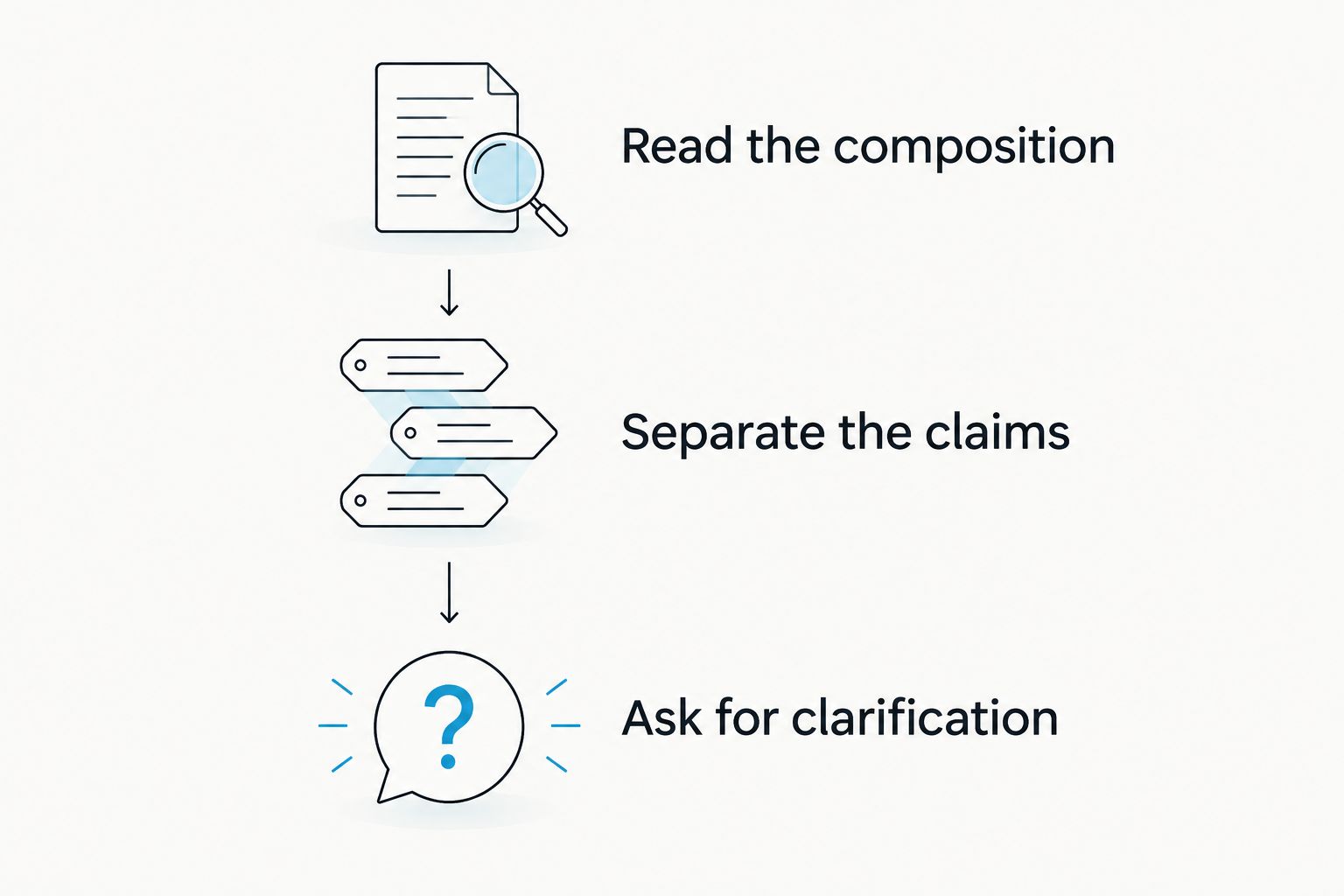
Read the composition
Find the material or composition statement. Look for camel leather explicitly, not just leather, camel or a desert-inspired product name. Check whether the statement refers to the exterior, a panel, a trim detail or the accessory as described overall.
Read the full product description as well as the title. If the two conflict, resolve the conflict before ordering; do not choose whichever wording you prefer.
Separate the claims
Treat animal source, colour and manufacturing location as distinct facts. Crafted in the UAE describes where the craftsmanship takes place; it does not, on its own, establish where the animal was raised or where the hide was tanned.
Apply the same care to other features. A material statement does not establish a closure type, a carrying capacity or a security feature. Each needs its own product information.
Ask for clarification
If the description remains unclear, ask whether the outer material is genuine camel leather and which components the statement covers. Make the question specific enough that a reply about colour or general leather quality will not answer it.
For a gift order, settle the material question before writing a message that describes the item. You should be able to explain what you are giving without adding claims the seller has not made.
A direct written answer is more useful than a broad assurance that an item is authentic or high quality. It still needs to answer your actual question: what material is used, and where?
Why do camel leather descriptions vary?
Different parts of a product page answer different questions. Read them together, but do not let one substitute for another.
- Colour terminology: Camel can appear as a shade name beside other colour choices. In that position, it does not identify the hide source.
- Material wording: Leather is a broader description than camel leather. The missing animal name is a question to resolve, not permission to assume.
- Component scope: A description can refer to an outer surface without explaining the lining, trim or other parts. Check what the wording covers.
- Craftsmanship location: A UAE manufacturing statement concerns where an item is crafted. It is separate from the origin of the hide.
- Presentation: Product titles, short previews and longer descriptions provide different amounts of detail. Read beyond the most prominent phrase.
Choose the clearest description, not the most elaborate story. Heritage language can provide context, but it does not replace a precise material statement.
Can you recognise camel leather from a photo or by touch?
You cannot reliably confirm camel-hide origin from a photograph or touch alone. Grain, colour and softness help you assess appearance and feel, but leather finishing affects those qualities. They are not a substitute for material information.
When examining an accessory in person, use the opportunity to check the product itself: look at stitching, edges, openings and the way it handles your belongings. Those observations help you judge workmanship and fit without pretending to identify species by inspection.
Avoid scratch, flame, soaking or solvent tests. They risk damaging the item and do not give you a dependable home method for establishing camel-hide origin. A buying decision should not require you to damage the accessory you are assessing.
Choose the colour after you confirm the material
Once you have established the material claim, colour becomes a separate styling decision. Consider the clothes, bags and other accessories you already use. You do not need a camel shade to choose camel leather, and you do not need camel leather simply because you want that shade.
For example, choosing a leather bag colour concerns how brown or black fits your wardrobe; it does not establish the animal source of either option. Keep that distinction when comparing a bag with a smaller everyday accessory.
For a gift, avoid choosing a colour solely because it appears to signal the material. Confirm the composition first, then consider the recipient's preferences. If you cannot establish their preferred shade, focus your questions on how they carry and use the item rather than inventing a preference for them.
Where Cam-Ora fits in your decision
Cam-Ora is for UAE shoppers choosing genuine camel leather accessories crafted in the UAE for everyday use or gifts. Its stated offer includes card holders, eyewear cases, passport holders and bags. That gives you an explicit material and craftsmanship starting point, rather than a colour-only description.
For a compact everyday accessory, the camel leather card holder is relevant if you want a card holder rather than a larger wallet. Confirm that its current product details suit what you carry; the material alone does not establish the right capacity or format for you.
The reason to consider Cam-Ora camel leather accessories is the stated combination of material, UAE craftsmanship and practical product types. The limitation is equally clear: those facts do not prove that every format suits every buyer, or establish unlisted features. Choose the object you need, not just the material you admire.
Does crafted in the UAE mean the hide comes from the UAE?
Crafted in the UAE identifies the stated craftsmanship location, not the animal's origin. Hide sourcing, tanning and product manufacture are separate stages, so do not combine them into a single origin claim without explicit information.
For corporate gifting in 2026, keep the same distinction in your purchasing brief and recipient message. If a particular sourcing origin matters to the order, request confirmation before describing it as a feature.
Is camel-coloured leather an imitation of camel leather?
Camel-coloured leather is not automatically an imitation of camel leather. It can be leather described by its shade, with no claim that the hide comes from camel.
Judge the wording in context. A clearly labelled colour choice is different from an explicit material claim, and your purchase decision should reflect which one you actually want.
What should you ask before ordering camel leather gifts?
Ask whether the item uses genuine camel leather, which components that statement covers and where it is crafted. Then check the practical details relevant to the recipient, such as the accessory type and intended use.
Keep any 2026 gift brief factual. Do not add personalisation, packaging, delivery or other services to your plan unless those details have been explicitly confirmed for your order.
FAQ
What's the difference between camel leather and camel-coloured leather?
Camel leather identifies the animal source of the hide; camel-coloured leather identifies a shade. Read the material description separately from the colour choice.
Does genuine leather mean it is camel leather?
Genuine leather alone does not establish that the hide comes from camel. Look for an explicit camel leather statement covering the item or relevant component.
Can I tell whether leather is camel leather from its grain?
Grain appearance alone cannot reliably establish camel-hide origin. Use the material description and ask for clarification rather than treating a visual pattern as proof.
Does camel leather have to be camel coloured?
Camel leather does not have to be camel coloured. Animal source and finished colour are separate characteristics, so check each independently.
Is camel-coloured leather fake leather?
Camel-coloured leather is not automatically fake leather. The colour term does not identify either the animal source or the full material composition.
Does made in the UAE confirm where the hide originated?
Made in the UAE does not, by itself, confirm where the hide originated. Manufacturing location and material sourcing need separate statements.
What does Cam-Ora sell in camel leather?
Cam-Ora sells genuine camel leather accessories crafted in the UAE, including card holders, eyewear cases, passport holders and bags. Check the individual product description for the details relevant to your purchase.
One last thing
The most useful distinction is also the easiest to overlook: camel leather and camel-coloured leather can both be accurate descriptions of an item, but they answer different questions. One concerns material; the other concerns appearance.
For your 2026 shortlist, keep those questions separate until both are answered. Then assess the accessory's practical design. A clear material description earns consideration, but the right purchase still needs to fit what you carry and how you use it.
Start with the material statement, then choose the format and colour. That order keeps a shade name from making the decision for you.