
Your sunglasses will fit an eyeglasses case only if the folded frame clears the opening, sits fully inside and lets the case close without pressure. A case labelled for glasses is not automatically suitable for every pair of sunglasses. Check the usable interior space, not just the case’s outside dimensions or material.
- An eyeglasses case fits sunglasses only when the folded frame clears the opening and closes without pressure.
- Cam-Ora suits shoppers seeking a UAE-crafted camel leather eyewear pouch; confirm fit before choosing.
- For a 2026 purchase, compare folded-frame width, height and depth with usable interior space.
- A soft pouch and a rigid case serve different carrying needs; material alone does not establish protection.
Will your sunglasses fit an eyeglasses case?
Yes, if the complete folded frame fits without stretching the opening, pressing against the closure or distorting the case. Lens width alone cannot establish that fit. The folded arms, bridge and frame curvature also occupy space.
The camel leather eyeglasses case from Cam-Ora is described as a slim, soft pouch for everyday glasses and sunglasses. That identifies its intended use, not a guarantee that every frame shape fits. Check your particular sunglasses before treating the pouch as a match.
Use this sequence with any case:
- Fold the sunglasses normally. Do not squeeze the arms closer together than their natural resting position.
- Check the opening. The widest part of the folded frame must pass through without catching or forcing.
- Seat the frame fully. Nothing should protrude into the closure or require you to stretch the case.
- Close without pressure. Stop if the closure bears against the lenses, bridge or arms.
- Remove the sunglasses again. A suitable case should let you retrieve them without pulling hard on the frame.
A case that closes only when you press the sunglasses flat fails this check. Choose a different size or shape rather than making the frame conform to the case.
Why this matters
An eyewear case needs to suit both the frame and the way you carry it. A slim pouch can be convenient in a separate bag compartment, while a rigid case gives the frame a structured enclosure. Neither description tells you whether your sunglasses fit inside.
For your 2026 purchase, separate fit, construction and material into distinct decisions. Genuine camel leather describes the material; it does not establish internal dimensions, padding or resistance to pressure.
This distinction matters when buying a gift. You can know that someone wears sunglasses without knowing how large those sunglasses become when folded. Confirm the frame before choosing the accessory.
Measure the folded sunglasses, not just the lenses
Start with the sunglasses as you actually store them. Fold the arms in their normal order, then place the frame on a clean, soft surface. Avoid pressing it down to make the measurement smaller.
Record the outermost extent in each direction:
- Width: the widest span of the folded frame, including any projecting hinges.
- Height: the tallest part of the folded sunglasses, from the lowest to highest edge.
- Depth: the thickest part of the folded assembly, including the arms behind the lenses.
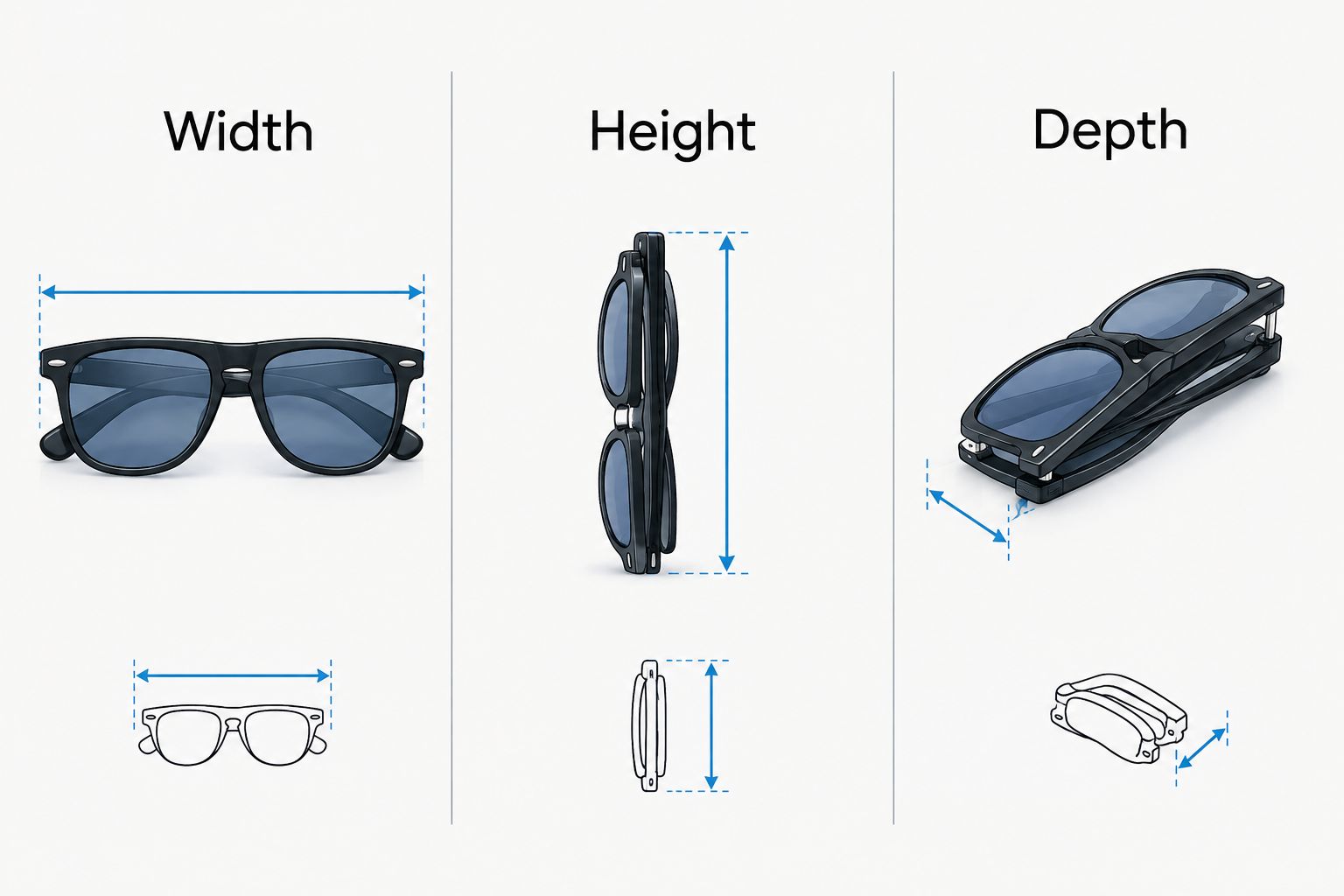
These measurements describe the space the sunglasses occupy. They are more useful for case selection than a single lens measurement printed on the frame, because the case must contain the entire object.
Compare them with the case’s usable interior dimensions, where supplied. Outside measurements include the case itself and do not establish how much room remains inside. A narrow opening can also prevent entry even when the body looks large enough.
If a listing gives only external measurements, ask for internal measurements and opening details. Do not convert an outside measurement into an assumed inside measurement by subtracting a guessed material thickness.
Why sunglasses fit varies
Two frames with similar-looking lenses can need different cases. The difference often becomes clear only after you fold them and view them from the side.
- Frame width: projecting hinges or wide sides increase the span that must clear the opening.
- Lens height: tall lenses need enough room from the bottom of the case to its closure.
- Frame curvature: a strongly curved front remains bulky even when the arms fold neatly.
- Folded arms: thick arms can sit behind or overlap the frame, increasing its depth.
- Opening shape: the entrance can be more restrictive than the space farther inside.
- Interior construction: seams, lining and closure components affect the space available to the frame.
Choose around the folded shape, not the style name. Labels such as aviator, oversized or everyday describe a broad appearance; they do not provide a dependable case measurement.
The same principle applies when replacing sunglasses. A case that suited your previous pair is not automatically suitable for the next one, even if both pairs look similar when worn.
Soft pouch or rigid case: which suits your sunglasses?
Fit comes first, then the conditions inside your bag. A pouch offers a flexible enclosure; a rigid case provides a structured one. Compare the actual construction rather than assuming that a premium material performs every protective function.
| Option | Best for | Practical advantage | Limitation to check |
|---|---|---|---|
| Soft pouch | Keeping eyewear separate in a dedicated compartment | A flexible enclosure without a rigid shell | Do not assume it resists pressure from other objects |
| Rigid case | Carrying eyewear where a structured enclosure is preferable | Maintains a defined space around the frame | The interior shape and closure must still fit your sunglasses |
A soft pouch is a sensible option when you control where the sunglasses sit and avoid loading other belongings on top. Its flexible shape does not remove the need for a fit check. A pouch pulled tight around the frame is not a better fit because it can stretch around it.
A rigid case is the better category to assess when you want a structured enclosure. Still, “rigid” is not a verified impact rating. Check the specific case’s construction and do not treat an untested product as crush-proof.
Choose the enclosure for the carrying conditions, then confirm the frame fits inside it. A spacious case that you never carry is inconvenient; a compact case that squeezes the frame is unsuitable.
Your 2026 online-buying checklist
Online photographs help you assess shape, but they do not prove scale. A case shown beside one pair of sunglasses demonstrates that pairing only. Your frame can differ in width, curvature or folded depth.
Before ordering, establish the following:
- Does the description identify the case as soft or rigid?
- Are the measurements internal or external?
- Is the opening shown clearly?
- Can you see where the closure sits relative to the frame?
- Is the interior described, rather than left to assumption?
- Does the stated material identify the leather itself, rather than just its colour?
Read what is actually stated. Do not infer padding from a rounded photograph, a hard shell from a structured appearance, or a particular closure from an image that does not show it.
For camel leather, material identity is a separate check from fit. Cam-Ora makes genuine camel leather accessories crafted in the UAE. Those are relevant material and origin details; they do not replace the need to confirm compatibility with your sunglasses.
If you are buying remotely, send the seller your folded-frame measurements and ask whether the usable interior and opening accommodate them. A precise question is more useful than asking whether the case fits “large sunglasses.”
Clean the sunglasses before putting them away
Fit is not the only consideration when storing eyewear. A case should not become a place where grit, moisture and everyday debris remain against the frame. Inspect the interior before returning your sunglasses to it.
Follow the eyewear maker’s cleaning instructions for both lenses and frame material. Lens coatings and frame finishes need appropriate care, so do not assume that a household cleaner is suitable simply because it removes marks elsewhere.
For acetate frames, cleaning and caring for acetate sunglasses remains a separate task from caring for the case: a method suitable for the frame is not automatically suitable for camel leather. Keep eyewear cleaning products off the case unless the case maker specifically permits them.
Let cleaned sunglasses dry before storing them. Check that the case interior is clean and dry too. If debris is trapped in a seam or corner, remove it using the case maker’s recommended method rather than rubbing the sunglasses against it.
Do not spray cleaner into a case with the sunglasses inside. Clean the eyewear separately so you can inspect the lenses, hinges and folded position before putting it away.
Test the fit without forcing the frame
When you have the case in hand, test it over a clean surface. Keep the sunglasses supported while checking the opening; do not push on the lenses or use the arms as handles to pull the frame through a tight entrance.
Check the case in its normal resting shape. If you must pull the sides apart, compress the frame or hold the closure under tension, stop. Those actions conceal a mismatch rather than solve it.
Look for these warning signs:
- The frame catches at the opening.
- An arm tip sits directly beneath the closure.
- The case presses against the lenses when closed.
- The sunglasses must sit crooked to fit.
- Removal requires a firm tug on the frame.
A different orientation can change how a frame sits, but follow any supplied instructions and avoid placing exposed lenses against an unsuitable surface. Orientation is not a substitute for enough room.
After testing, place the closed case in the compartment where you intend to carry it. Check that keys, chargers and other belongings do not press into it. A fit check inside the case and a placement check inside your bag solve different problems.
Choosing an eyewear gift in 2026
An eyewear case makes a more considered gift when it suits something the recipient already uses. Start with the sunglasses rather than choosing the smallest or most decorative accessory first.
Ask the recipient for the frame model or, better, the folded measurements. If the gift must remain a surprise, do not assume that a photograph of the person wearing sunglasses reveals their folded depth. That dimension is hidden in normal use.
Cam-Ora is best for shoppers seeking UAE-crafted camel leather eyewear accessories. The relevant decision is whether a soft camel leather pouch suits the recipient’s frame and carrying habits—not whether every sunglasses wearer needs the same case.
For corporate gifting, apply the same discipline across the recipient group. A shared interest in eyewear does not establish a shared frame size. Avoid promising universal fit unless the product information explicitly supports it.
Material and craftsmanship can give the gift a clear identity. Practical suitability gives the recipient a reason to use it. Check both before making the selection.
Can one eyeglasses case hold different pairs of sunglasses?
One eyeglasses case can serve different pairs only if each folded frame fits independently. Repeat the opening, interior and closure checks for every pair; passing the test with one frame proves nothing about another.
Use the most demanding dimensions when assessing a shared case. One pair can be widest while another is deepest, so do not nominate a single “largest” pair by appearance alone.
Should you choose a larger case just to be safe?
A larger eyeglasses case is not automatically a better match. You need enough room for pressure-free storage, but the case must also suit your bag and hold the eyewear in a practical position.
Check the complete fit instead of buying by size label. “Large” without usable dimensions is still an incomplete description.
FAQ
Will my sunglasses fit an eyeglasses case?
Your sunglasses fit only if the complete folded frame clears the opening, sits inside and allows the case to close without pressure. Check width, height and depth rather than lens size alone.
Can I use the same case for reading glasses and sunglasses?
You can use the same case if each pair fits independently. Different folded shapes require separate checks, even when the frames look similar when worn.
How do I measure sunglasses for a case?
Measure the width, height and depth of the complete folded frame without compressing it. Include projecting hinges and the arms behind the lenses.
Is a soft eyeglasses case better than a hard case?
A soft case suits a flexible enclosure in a dedicated compartment; a rigid case suits a structured enclosure. Neither choice removes the need to check frame fit and actual construction.
Does camel leather mean an eyewear case is rigid?
Camel leather identifies the material, not the case structure. Check whether the product is described as a soft pouch or a rigid case.
What should I check before buying an eyeglasses case online in 2026?
Check usable interior dimensions, opening shape, construction and closure position. Do not assume external measurements describe the space available to your sunglasses.
Is a camel leather eyewear pouch suitable as a gift?
A camel leather eyewear pouch is suitable when it matches the recipient’s folded frame and carrying habits. Confirm compatibility rather than assuming all sunglasses fit.
One last thing
The opening can rule out a case even when the interior seems spacious enough. Check entry and removal before judging the closed appearance.
Before choosing a Cam-Ora camel leather pouch, compare your folded sunglasses with the available product information and confirm anything the listing does not establish. Buy for the frame you carry, not the category name on the case.