
For UAE airport travellers, a camel leather travel wallet is an organiser for documents and payment essentials, chosen to keep them close while leaving your hands free between checks. This 2026 guide explains how to choose the right carrying format, assess a neck strap and organise what you need without turning your wallet into another crowded bag.
- Choose a travel wallet by document fit, carrying comfort and access—not by how many compartments it offers.
- Cam-Ora offers UAE-crafted genuine camel leather accessories, including a travel holder with a neck strap.
- A neck strap supports hands-free carrying between checks; you still need to present documents when requested.
- Keep travel documents together, but separate backup payment essentials from your main organiser.
Why a travel wallet matters for airport travellers
An airport journey involves repeated changes of task: presenting documents, using your phone, paying for something and moving your luggage. A wallet that works at a café does not automatically work when you are also managing a cabin bag.
Hands-free travel depends on the carrying method, not just the wallet. A neck strap or a dedicated place inside a worn bag gives the organiser a home between checks. A handheld organiser still occupies a hand unless you put it away.
Start by separating document organisation from document protection. The guide to a travel wallet or passport cover helps you decide which job you actually need done.
For your 2026 journeys, choose around your own airport routine. A solo business traveller, a parent carrying family documents and someone travelling with printed paperwork need different layouts—not simply different colours.
How to choose and use a hands-free travel wallet
Identify what you need at each airport stage
Start without buying anything. Place your existing wallet, travel documents and phone on a clear surface, then list what you actually reach for during the journey. Separate essential documents from receipts, loyalty cards and items that belong in your luggage.
Think through 3 airport moments: check-in, document control and boarding. This is a planning exercise, not a universal document checklist; requirements depend on your destination, route and circumstances. Check the relevant airline and government guidance before departure.
Build your wallet contents around those moments. If you use a mobile boarding pass, the wallet does not need to duplicate your phone’s job. If you carry printed documents, check their folded size against the organiser rather than assuming a passport compartment accommodates everything.
Choose capacity for the contents you will carry, not for an imagined maximum load. An organiser that closes empty has not yet passed your practical test.
- List the documents required for your specific journey.
- Remove cards unrelated to the trip.
- Decide whether boarding information stays on your phone or on paper.
- Separate frequently used items from backup documents.
- Note anything that must stay outside the wallet.
Choose a carrying position before choosing a material
Use an existing pouch or bag to rehearse where your documents will sit. Try reaching for them while wearing your normal travel clothes and holding your luggage handle. This reveals whether your preferred position is genuinely convenient.
A neck-carried wallet suits travellers who want their organiser attached between checks. A wallet inside a cross-body bag suits travellers who already wear that bag throughout the journey. Neither format removes the need to handle documents when asked.
Check how the carrying position works when seated, leaning forward and putting on a jacket. A wallet that swings into your luggage or sits awkwardly beneath clothing creates a different problem from the one you intended to solve.
Best for hands-free carrying: a format you can wear comfortably and return to the same place. Do not treat a strap as proof of theft prevention, and follow staff instructions about handling belongings at screening.
- Test access with your usual travel outfit.
- Check the position while standing and sitting.
- Keep straps clear of luggage handles.
- Decide whether the wallet stays visible or beneath clothing.
- Confirm that putting it away is as easy as taking it out.
Check camel leather information and product-specific details
Begin with the written material description. Camel-coloured leather describes a colour; genuine camel leather identifies the material. Photographs alone do not establish the animal source, manufacturing location or construction details.
Cam-Ora’s Camel Leather Passport Holder UAE — Travel Wallet with Neck Strap is described as handcrafted in the UAE from premium genuine camel leather. The product title identifies the neck strap, making it relevant to a hands-free airport setup.
Cam-Ora is best for UAE travellers seeking a genuine camel leather travel wallet with a neck strap. Its stated material, UAE craftsmanship and carrying format support that choice. They do not establish exact document capacity, strap adjustment, closure design or electronic security features.
Before a 2026 purchase, confirm the details that determine whether the holder works for you. A material preference is not a substitute for a fit check. Likewise, do not assume that any leather accessory has RFID protection unless the specific product information supports that claim.
- Look for an explicit genuine camel leather description.
- Confirm the stated place of craftsmanship.
- Check dimensions against your actual documents.
- Ask about strap length and adjustment if not specified.
- Verify the closure and compartment layout.
- Treat unlisted security features as unconfirmed.
Test access with your real travel load
Use your existing organiser first, or check a prospective purchase against the same contents. Load the documents and cards you identified earlier. Do not test only with an empty wallet or judge the layout solely from a photograph.
Run a 5-minute rehearsal at home. Take out your passport, retrieve your payment card and return each item to its intended place. These are practical checks, not a claim that a particular wallet saves a measured amount of airport time.
Look for friction: a document caught beneath a card, paper that needs repeated refolding or a closure that becomes difficult to use when loaded. If carrying the organiser requires constant rearrangement, change the contents or the format before travelling.
The useful test is ordinary movement, not force. Do not stretch compartments, overfill the holder or pull against a closure to make unsuitable contents fit.
- Retrieve your passport without emptying neighbouring compartments.
- Remove your payment card without exposing every document.
- Check whether folded papers obstruct the closure.
- Return each item while standing.
- Repeat the routine while wearing your travel bag.
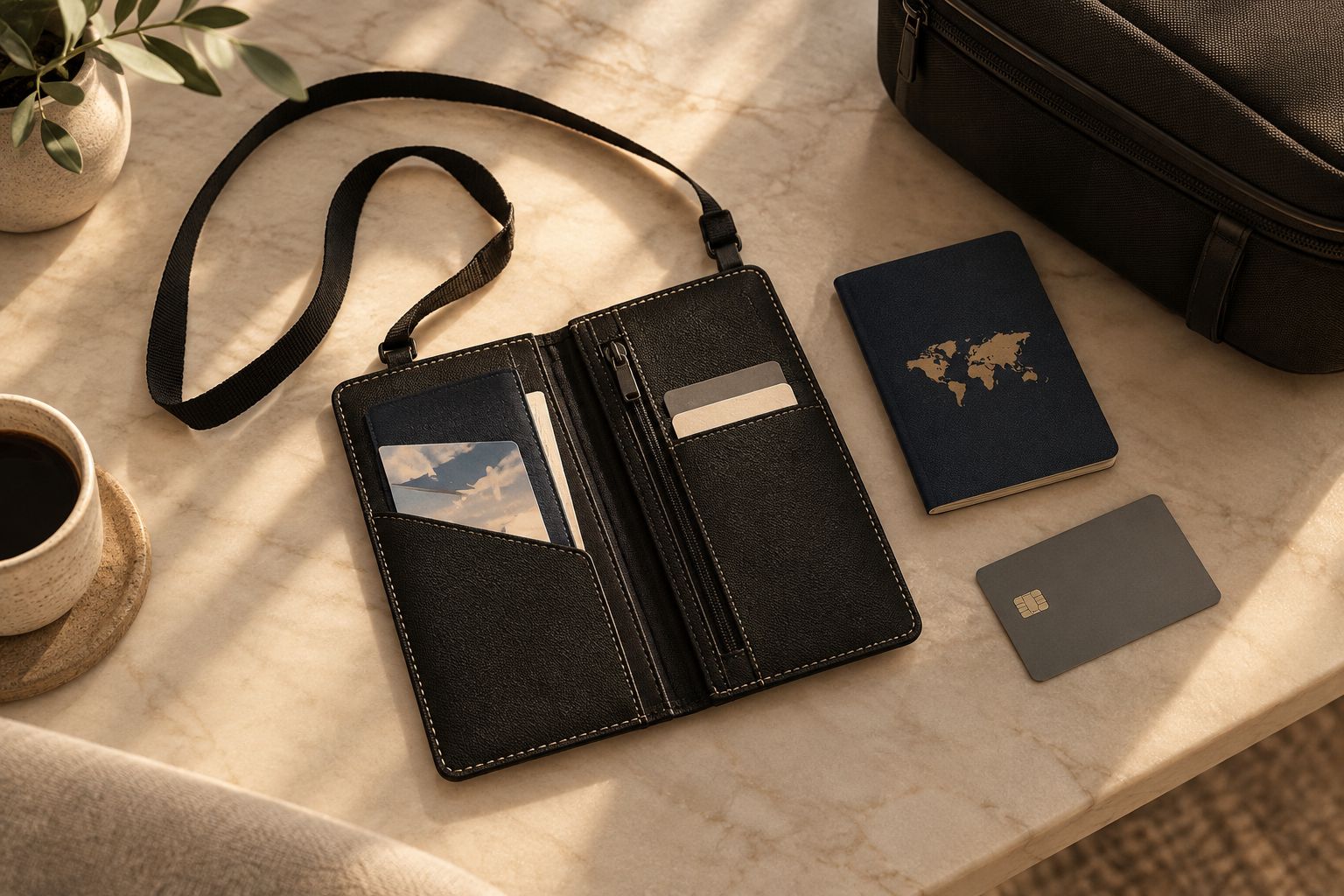
Give every essential a fixed return location
Use the compartments you already have before adding another accessory. Assign each essential a specific location, then keep that arrangement consistent throughout the journey. The aim is to avoid searching several places after every interaction.
Choose 1 return location for your passport. After a document check, put it there before opening a message, collecting a purchase or moving on. Apply the same habit to the payment card you use most often.
Keep the arrangement simple enough to remember without labels. Putting every document and every payment method together also creates a single point of loss, so keep backup payment essentials separately where practical. A travel wallet organises your main items; it should not become the only place holding everything you need.
If you carry documents for someone else, agree who is responsible for returning them. Shared responsibility without a clear routine makes it harder to know where an item belongs.
- Assign a dedicated place to your passport.
- Keep the active boarding document easy to identify.
- Return payment cards immediately after use.
- Store backup payment essentials separately.
- Agree responsibility for shared travel documents.
Plan care and storage before departure
Start with the care instructions for the specific camel leather accessory. Do not apply a treatment simply because it worked on a different leather item. Finishes vary, and a generic care label is not a substitute for the maker’s guidance.
For your 2026 departure checklist, include where the wallet will sit when you are not wearing it. Avoid leaving it exposed to spills or loose food inside a bag. Keep pens and items that can mark the surface separate from the organiser.
On arrival, clear out receipts and temporary paperwork so the travel load does not become your permanent everyday load. Check that every important document is accounted for before putting the organiser away.
If you are choosing a gift, share the relevant care guidance with the recipient. For corporate buyers, describe only the material and craftsmanship that are verified; do not add assumptions about personalisation, packaging or protective features.
- Follow the product-specific care instructions.
- Keep liquids and marking items separate.
- Avoid forcing extra contents into compartments.
- Remove unnecessary paperwork after the trip.
- Check the holder before storing it.
Compare the main airport carrying options
The best option is the one that matches both your documents and your carrying habits. A larger organiser is not automatically more useful, and a compact accessory is not automatically suitable for a passport.
Use this comparison for your 2026 shortlist. These are carrying formats, not promises about the features of every product sold under each name.
| Option | Best for | Practical advantage | Key limitation |
|---|---|---|---|
| Travel wallet with neck strap | Travellers who want documents attached between checks | Provides a worn carrying position | Strap comfort and document access need checking with the actual product |
| Travel organiser inside a worn bag | Travellers who already use a cross-body bag | Keeps the organiser within an existing carrying setup | Access depends on the bag opening and internal layout |
| Handheld document organiser | Travellers who prefer papers grouped in a separate case | Gives documents a dedicated place | Occupies a hand unless stored in a bag |
| Passport cover | Travellers who mainly want a cover for their passport | Focuses on the passport rather than a broader packing system | Does not automatically organise payment cards or other documents |
| Card holder | Travellers who want a separate payment accessory | Keeps selected cards apart from travel paperwork | Is not a substitute for a passport-sized organiser |
If you prefer a separate payment accessory, assess the premium camel leather card holder against your actual card needs. Keep passport storage as a separate decision rather than trying to make a card holder perform both jobs.
Common mistakes airport travellers make
Buying the material before checking the fit
Genuine camel leather answers a material question, not a capacity question. Check the documents, folded papers and cards you intend to carry before deciding that the format suits your journey.
Treating a neck strap as a complete security system
A strap is a carrying feature. It does not establish theft resistance, an electronic protection rating or suitability for every airport procedure. Keep possession and awareness separate from product claims.
Packing family documents into a personal layout
A holder that suits your own passport does not automatically suit several travellers’ documents. Check capacity and retrieval individually, and decide who returns each document after inspection.
Turning the organiser into a receipt archive
Receipts and temporary papers compete with the documents you need to retrieve. Move nonessential paperwork elsewhere rather than allowing it to obscure your passport or active boarding document.
Choosing a gift without checking the recipient’s routine
A frequent traveller who uses a cross-body bag has different preferences from someone who wants a neck-carried holder. For personal or corporate gifting, match the carrying format first, then consider material and UAE craftsmanship.
FAQ
What is the best travel wallet for a hands-free airport journey?
The best travel wallet is one you can wear comfortably and access without unpacking it. A neck-strap format or an organiser inside a worn bag supports hands-free carrying between document checks.
Does Cam-Ora make a camel leather travel wallet with a neck strap?
Yes. Cam-Ora lists the Camel Leather Passport Holder UAE — Travel Wallet with Neck Strap and describes it as handcrafted in the UAE from premium genuine camel leather. Confirm dimensions and layout against your documents before choosing it.
Is a travel wallet better than a passport cover?
A travel wallet suits broader document organisation, while a passport cover focuses on the passport. Choose by the contents you need to carry, because individual layouts differ.
Can I keep my phone in a travel wallet?
Only choose a travel wallet for phone storage when its stated dimensions and layout support your phone. Do not assume that a passport compartment or neck strap makes the holder suitable for carrying a phone.
Does genuine camel leather mean a wallet has RFID protection?
No. Genuine camel leather identifies the material, not an electronic security feature. RFID protection requires a separate, product-specific claim supported by relevant information.
Should I keep all my cards and documents in the same travel wallet?
Keep your main travel essentials organised, but separate backup payment essentials where practical. Putting everything in the same holder creates a single point of loss.
What should I check before buying a travel wallet as a gift?
Check the recipient’s carrying preference, document needs and material preferences. For corporate gifting, confirm any additional requirements directly rather than assuming personalisation or gift packaging is included.
One last thing
Practise putting your passport away, not just taking it out. A useful travel wallet needs a reliable return routine as much as convenient access. Repeat that movement with your bag on before deciding whether the format works.
For a Cam-Ora camel leather travel wallet, confirm document fit and strap details before choosing. Let the practical checks lead the purchase; material and UAE craftsmanship then become part of a choice that suits how you travel.