
Choose a soft eyeglasses case for slim everyday carry when your glasses stay away from pressure; choose a hard case when they share space with heavier belongings. A soft pouch does not provide the rigid barrier of a hard shell, while a hard case still needs enough internal room to close without pressing against your frames.
- A soft eyeglasses case suits controlled everyday carry; a hard case adds structure against pressure.
- Cam-Ora offers a genuine camel leather soft pouch, handcrafted in the UAE for everyday use.
- Check frame fit, interior cleanliness and closure clearance before choosing either case type.
- Camel leather describes the material, not a case’s resistance to crushing.
Why this matters: Your glasses need a case that suits where you put them, not just how the case looks. For a 2026 purchase, start with your carrying habits: a separate compartment creates a different situation from a crowded work bag.
The camel leather eyeglasses pouch from Cam-Ora is a soft-case option. Treat its material and construction as separate considerations when deciding how to carry your glasses.
Soft eyeglasses case or hard case: which do you need?
Choose according to pressure exposure first, then fit and convenience. A flexible pouch and a rigid case solve different carrying problems; neither deserves a recommendation based on its outer material alone.
| Case type | Best for | Main advantage | Main limitation | Check before choosing |
|---|---|---|---|---|
| Soft case | Everyday carry in a separate, uncrowded compartment | Flexible construction suits compact storage | Does not create a rigid barrier around the frames | Opening, internal fit and where you will store it |
| Hard case | Bags where other objects press against the case | A rigid shell provides more structure | Takes up a fixed amount of space, even when empty | Shell, closure and clearance around the glasses |
Think about the moment your bag gets packed, rather than the moment you place the glasses inside. A pouch that sits comfortably beside your notebook can face a different load once a bottle or laptop goes into the same compartment.
A hard case is not permission to overpack. Its shell, hinge and closure still need to work together, and the glasses must fit inside without being forced into position.
Soft eyeglasses cases: best for controlled everyday carry
A soft case suits you when you know where your glasses will sit throughout the day. Examples include a dedicated handbag compartment, a separate jacket pocket or an uncrowded desk drawer.
Its practical advantage is flexibility. Unlike a rigid shell, the empty pouch does not retain the same fixed shape, although its actual bulk depends on its construction.
Cam-Ora’s camel leather eyewear pouch is best for shoppers seeking a slim, UAE-crafted soft case for everyday carry. Its stated details are genuine camel leather, handcrafted construction and a practical everyday format—not verified resistance to crushing.
The limitation matters. Do not select a soft case as your answer to pressure from books, a packed laptop compartment or other heavy contents. Choosing a premium material does not change a flexible pouch into a rigid enclosure.
Before buying, consider how you remove your glasses. The opening should let you insert folded frames without forcing the arms or dragging the lenses against an edge. Check the interior too; an attractive exterior does not answer questions about the surfaces touching your eyewear.
Choose a soft case when you can control its surroundings. If you cannot keep pressure away from the glasses, choose more structure instead.
Hard eyeglasses cases: best for pressure-prone bags
A hard case suits situations where your glasses travel among objects that move, stack or press together. Its rigid construction creates a barrier that a flexible pouch does not provide.
The trade-off is space. A hard case keeps its shape when empty, so it needs a dedicated footprint in your bag. Check that footprint against your actual carrying space rather than buying a larger case without a reason.
Inspect the closure as carefully as the shell. A case that looks substantial but cannot close properly around your frames is the wrong fit. The lid should meet the base without using the glasses as a support.
Hard cases also need clean interiors. A shell does not make trapped dust or grit harmless, and an enclosed space still needs checking before you return your glasses to it.
Choose a hard case when pressure is the main concern. Do not assume that a rigid exterior guarantees protection against every impact or load; that requires evidence about the particular case, not a category label.
Your 2026 buying checklist: check fit before material
Start with the glasses you actually wear. Frame width, folded-arm position and lens shape affect fit more directly than a case’s description as premium, compact or suitable for everyday use.
Check the folded shape
Fold the arms normally and look at the full outline of the glasses. The widest point is not always the only point that needs room; the bridge, curved lenses and stacked arms also occupy space.
If shopping online, compare any published internal measurements with your folded frames. External measurements do not establish usable space inside a case. If the information does not resolve fit, ask before ordering.
Check the interior
Look for a clean interior without exposed edges or debris where the lenses will sit. If the case has lining, inspect its condition rather than treating the word lined as proof of scratch prevention.
Follow your eyewear manufacturer’s cleaning instructions before putting dirty glasses away. A case stores glasses; it does not clean them.
Check the closure
Close the case gently with the glasses in their normal position. Stop if you need to squeeze the frames, flatten the arms or push against the lenses to make it shut.
For an open pouch, check how easily the glasses slide in and out. For a case with a closure, check that the closing mechanism stays clear of the frames.
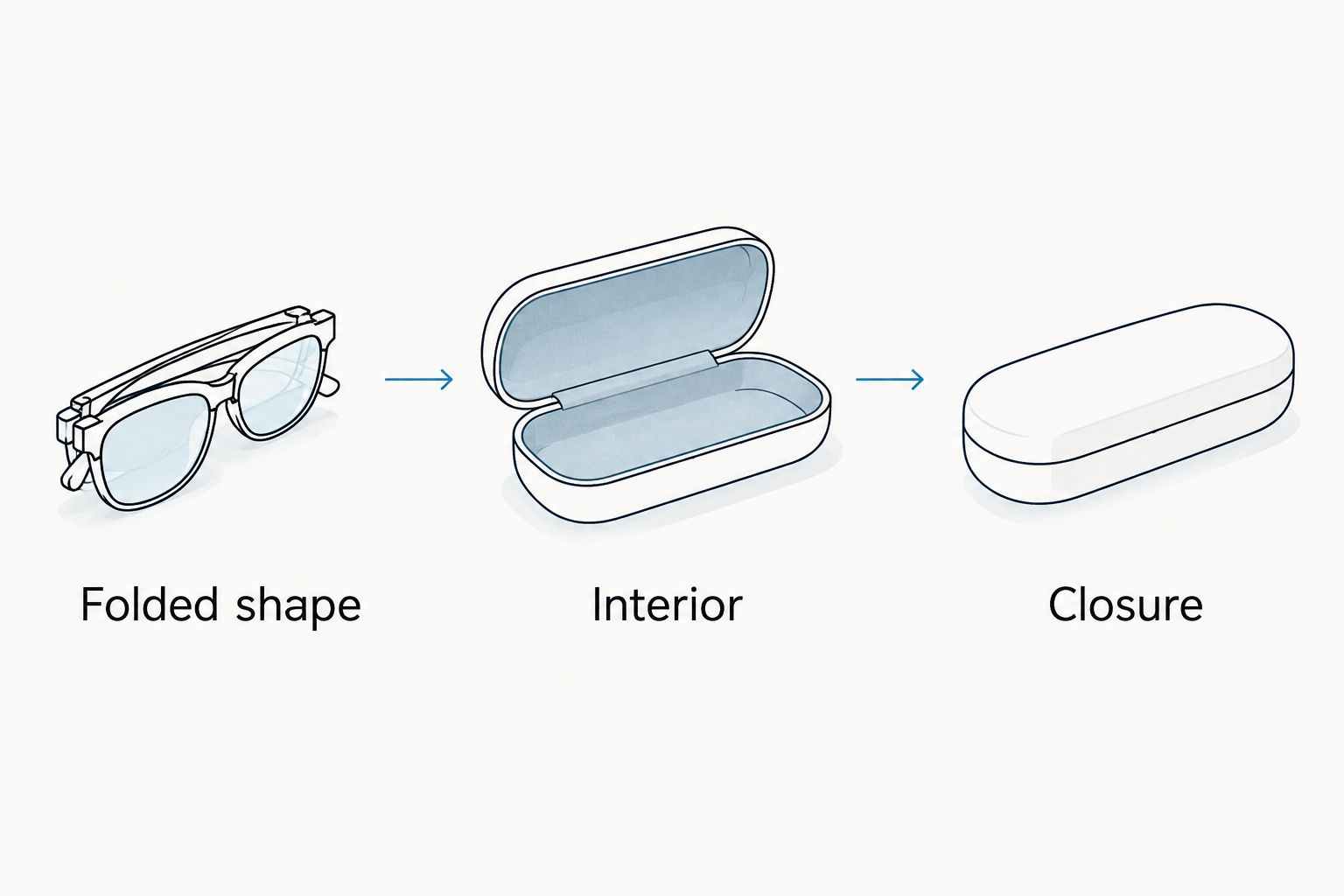
A useful fit check ends with an ordinary action: putting the glasses away without adjusting their shape. If storage requires an awkward manoeuvre every time, choose a different fit.
Why the right eyeglasses case varies
Your carrying conditions determine which compromises make sense. Use these factors to separate a suitable case from one that simply looks appealing:
- Bag pressure: Choose rigid construction when other belongings press against the case. Choose a soft pouch only when you can keep that pressure away.
- Frame shape: Deep lenses, curved frames and folded arms need appropriate clearance. Do not assume a case fits because it accommodates another pair of glasses.
- Storage space: Compare the case with the compartment you intend to use. A case that cannot sit sensibly in your bag creates another carrying problem.
- Opening and closure: Check access as well as containment. You should not need to force your frames through an opening or close a lid against them.
- Interior condition: Inspect for debris, wear and exposed surfaces. Both soft and hard cases require attention to the surfaces around the lenses.
- Material care: Match cleaning and storage to the particular case’s instructions. Guidance for a plastic shell does not automatically apply to camel leather.
Do not let the outer material answer questions it cannot resolve. Material identity, frame fit and structural protection are separate checks, even when they appear together in a product description.
Does a camel leather case protect better than another soft case?
Camel leather identifies the material; it does not establish that a soft eyeglasses case protects better than another design. Compare construction, fit and interior details before making a protection claim.
For Cam-Ora, the verified material and origin are genuine camel leather and UAE craftsmanship. Those details explain what you are buying, but they do not establish a tested impact rating or a guarantee against lens damage.
When reading product descriptions in 2026, distinguish a stated fact from an implied benefit. Handcrafted describes how an item is made; it does not, by itself, establish how much pressure the finished case withstands.
Use the same discipline with any accessory purchase. The guide to checking camel leather product claims before buying explains what to examine beyond the material name.
Should you use a hard eyeglasses case for travel?
A hard eyeglasses case is the more suitable choice when travel puts your glasses alongside compressed or shifting belongings. The reason is its structure, not the fact that you are travelling.
A carefully separated pouch in a day bag presents a different situation from eyewear packed beneath other items. Decide where the glasses will sit before deciding which case to take.
Keep access in mind too. If you change between prescription glasses and sunglasses, choose storage that lets you put the unused pair away without forcing it into an unsuitable space.
Do not use either case as an excuse to ignore placement. Keep glasses away from avoidable pressure, and follow the eyewear maker’s instructions on heat exposure and storage. A case is not evidence of heat protection.
What should you check when buying an eyeglasses case as a gift?
An eyeglasses case is a more considered gift when you know the recipient’s frame type and carrying habits. Material preference matters, but it cannot compensate for a case that does not fit.
For a 2026 gift shortlist, confirm whether the recipient uses reading glasses, everyday prescription frames or sunglasses. Do not assume those pairs share the same folded dimensions.
A soft camel leather pouch suits someone who values the material and has a suitable place to carry it. A hard case suits someone whose glasses need more structure around them. Neither choice is universal.
For corporate gifting, apply the same fit questions across the intended recipients. Cam-Ora serves corporate gifting buyers, but do not infer personalisation, packaging or other services from that alone. Confirm any requirements directly before committing to a particular accessory.
Avoid these case-buying mistakes
Choosing appearance before fit. A case can look right and still press against the bridge or folded arms. Establish usable internal space before considering the finish.
Treating softness as cushioning evidence. A flexible outer material does not establish what padding is inside. Check the actual construction rather than filling in details the description does not state.
Treating hardness as an unlimited guarantee. A rigid shell offers structure, but its closure and internal fit still matter. Avoid claims that imply every hard case handles every load.
Ignoring the storage routine. Consider where the case goes when you take your glasses out and where it sits when you put them away. A suitable case should fit that routine without encouraging you to leave glasses loose.
Using the same care method for every material. Follow the instructions for the particular case. Keep leather-care products off your lenses and avoid assuming a product intended for the exterior belongs inside.
FAQ
Is a soft or hard eyeglasses case better?
A hard eyeglasses case is better for carrying situations involving pressure; a soft case suits a separate, uncrowded space. Check frame fit and closure clearance with either type.
Can a soft eyeglasses case stop my glasses getting crushed?
A soft eyeglasses case does not provide a rigid barrier against crushing. Choose a hard case when pressure from other belongings is the main concern.
Will a hard case fit all glasses?
A hard case will not fit all glasses. Check internal space against your folded frames, including lens depth and the position of the arms.
Is camel leather the same as a hard protective shell?
Camel leather is a material, not a structural protection rating. A camel leather case can be soft, so check the construction rather than relying on the material name.
What kind of eyeglasses case does Cam-Ora offer?
Cam-Ora offers a slim, genuine camel leather eyeglasses pouch handcrafted for everyday use in the UAE. It is a soft case, not a rigid-shell case.
Can I use one case for prescription glasses and sunglasses?
You can use the same case for either pair only if each pair fits correctly when stored separately. Check both folded shapes rather than assuming matching fit.
What should I check before buying an eyeglasses case in 2026?
Check frame fit, interior condition, closure clearance and your intended carrying space before buying an eyeglasses case in 2026. Then choose the material and finish you prefer.
One last thing
An empty case fitting your pocket does not prove that your glasses fit the case. Make the decision with the frames inside, or with reliable internal measurements if you are shopping online.
For your 2026 purchase, choose structure for pressure and a soft pouch for controlled carry. If genuine camel leather and UAE craftsmanship suit what you want, review the Cam-Ora pouch’s current product details and resolve fit before ordering.