
Choose a genuine camel leather card holder by checking that it fits your daily cards, sits comfortably in your usual pocket and has neatly finished edges and stitching. For everyday carry in 2026, practical fit matters more than decorative detail. Confirm the material and craftsmanship before buying, and treat security claims as a separate question rather than a reason to overlook an awkward design.
- Choose a leather card holder by daily card fit, pocket comfort and clearly stated material details.
- Cam-Ora suits shoppers seeking genuine camel leather accessories crafted in the UAE.
- Minimalist design works only when your essential cards remain easy to reach.
- Check RFID claims separately; a feature label is not evidence of absolute protection.
Why this matters
A card holder should simplify what you carry, not make every payment inconvenient. A design that looks compact when empty still needs to suit your cards, clothing and routine when loaded.
Cam-Ora is best for shoppers seeking a UAE-crafted genuine camel leather card holder. Start with the camel leather card holder, then assess its details against your actual carry needs. Material and origin establish what you are buying; fit determines whether you will use it.
The main trade-off is straightforward: a minimalist accessory asks you to be selective. If you routinely carry folded receipts, coins or documents, include those needs in your decision rather than assuming they will fit somewhere.
How do you choose a camel leather card holder for everyday carry?
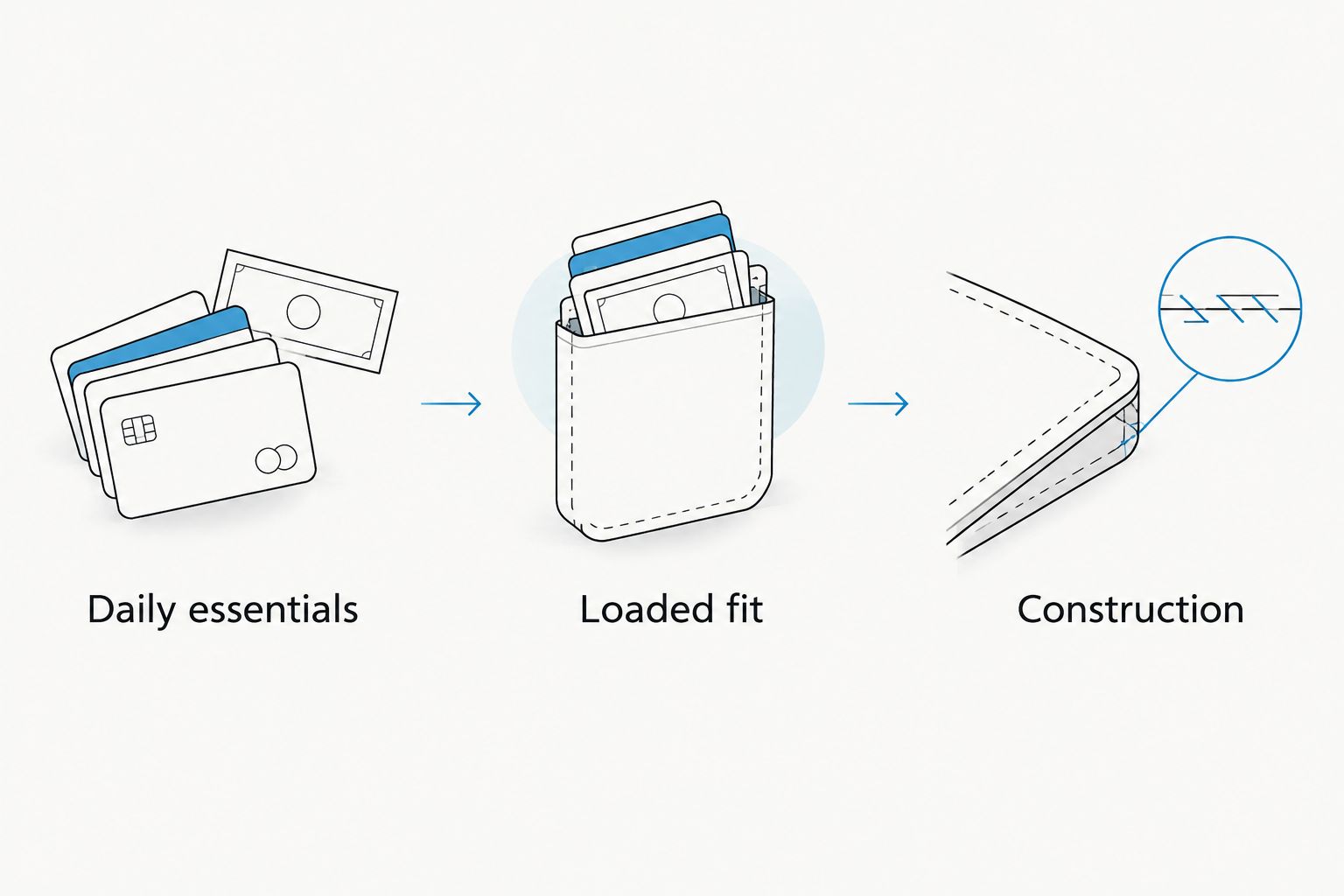
Use a 3-part check: daily essentials, loaded fit and construction. This gives you a repeatable way to compare card holders in 2026 without relying on broad quality claims.
- Daily essentials. Lay out everything from your current wallet. Separate cards you use regularly from occasional cards, receipts and other items. Assess the new holder against the essentials, not the clutter you intend to stop carrying.
- Loaded fit. Check stated capacity and dimensions, then consider access with your intended cards inside. When handling a sample, insert and remove cards without forcing them. A tidy appearance is not enough if retrieving your payment card becomes a struggle.
- Construction. Inspect the card-slot openings, stitching, corners and edge finishing. Look for consistent workmanship rather than judging quality from a dramatic close-up of the leather grain alone.
If you buy online, use the product description alongside photographs. A front-facing image cannot show every opening, seam or internal compartment. Check that the details answer your needs before deciding.
Make the card inventory honest
Include the physical cards you actually need: payment, identification, driving or building access, as applicable to your routine. Do not assume that a card can stay at home simply because another card performs a similar-looking function.
Keep occasional-use items separate during this exercise. You can then decide whether a smaller daily carry arrangement is practical or whether your current wallet format remains the better choice.
Which everyday carry format suits you?
A camel leather card holder is not automatically the right replacement for every wallet. Choose the format around the objects you need to carry together.
| Format | Best for | Practical advantage | Limitation to consider |
|---|---|---|---|
| Card holder | Card-focused everyday carry | Keeps the purchase decision centred on card storage and access | Check any provision for notes, coins or receipts rather than assuming it exists |
| Traditional wallet | Carrying cards with other small essentials | Offers a broader format to assess when cards are not your only requirement | Extra compartments do not help if they encourage you to carry unwanted items |
| Passport holder | Journeys that require travel documents | Gives travel paperwork a dedicated place | A travel-focused format is not a substitute for checking everyday pocket fit |
Choose a card holder when your daily essentials are predominantly cards. Keep a broader wallet format if reducing its contents would create inconvenience rather than solve it.
You do not need every accessory to perform every task. Keeping everyday cards separate from travel documents is a practical choice if it matches how you use them, not a requirement to buy another item.
How much card capacity do you actually need?
Use your essential-card inventory as the starting point. Count cards, not just visible slots: slot layout and stated total capacity are different details, and neither should be guessed from the front photograph.
Check how your most-used card is accessed. Consider whether you must remove another card first, unfold the accessory or shift the contents to reach it. These small actions are central to everyday usability.
Do not buy around an assumed stretching allowance. Choose a holder whose stated intended use matches what you plan to carry, rather than expecting the material to accommodate an overloaded arrangement.
For cash, be specific about your habit. Occasionally carrying a folded note is different from routinely carrying notes and receipts. Look for an explicit description of suitable storage instead of treating every opening as a general-purpose compartment.
A useful buying question is: can you explain where each essential item will go? If the answer depends on squeezing several unrelated objects into an unconfirmed space, reconsider the format.
What should you check about genuine camel leather?
Look for an explicit statement that the accessory is made from genuine camel leather. A desert-inspired product name, a brown colour or a textured surface is not a substitute for material information.
Cam-Ora describes its card holder as handcrafted from genuine camel leather, with UAE craftsmanship central to the brand. That gives you a concrete material and origin to assess. It does not remove the need to check the individual product’s layout and practical fit.
When comparing listings in 2026, distinguish the material description from general praise. Words such as premium or luxurious describe positioning; they do not specify capacity, dimensions, care requirements or construction details.
Avoid deciding authenticity from grain photographs alone. Lighting, image processing and the section photographed all affect what you see. Ask for clear material information rather than treating a particular surface pattern as proof.
The same discipline applies to environmental claims. Genuine camel leather identifies a material; it does not, by itself, establish a particular sourcing standard, certification or environmental outcome.
What does good workmanship look like?
Inspect the parts you will handle repeatedly: slot mouths, outside corners, stitched seams and finished edges. Look for an orderly finish and consistent construction across the accessory, not just its most photogenic surface.
Use close-up images to examine whether stitching follows a deliberate path and whether the edges look evenly finished. If you handle the item, check for loose threads or rough areas that interfere with inserting and removing cards.
Handcrafted describes how an item is made; inspect how that work is finished. The word alone does not tell you how the holder will fit your cards or feel in a pocket.
Check the interior as carefully as the exterior. Ask what materials are used where the listing is unclear, especially if an internal finish matters to your purchase. Do not assume every internal component uses the same material as the outside.
For Cam-Ora, the relevant starting points are genuine camel leather, handcrafting and UAE origin. Keep your final assessment practical: material information should sit alongside usable openings, a suitable layout and the details visible on the individual piece.
Will it feel comfortable in your everyday pocket?
Assess pocket comfort with your intended contents, not with the holder empty. The useful question is whether the loaded accessory suits the clothing you wear most often.
Compare 2 pocket positions, such as a trouser pocket and a jacket pocket, if both belong to your routine. Check access while standing and sitting. This is a suggested fit check, not a claim that a particular holder suits every pocket.
For an online purchase, compare the stated measurements with an accessory you already own. That gives you a physical reference without relying on how large the item looks beside a model’s hand.
If you carry a bag, consider where the holder will sit and how you will find it. A compact accessory is useful only if your storage arrangement keeps it accessible.
Do not let appearance settle the decision before comfort does. A colour you like cannot compensate for a format you avoid carrying.
Why the right card holder varies between shoppers
The best everyday choice changes with your routine, not with a universal claim about the smallest or most luxurious design.
- Daily contents: the cards and other essentials you genuinely need determine the format to assess.
- Access habits: frequent card retrieval makes the position and usability of openings important.
- Clothing: your usual pockets provide a more relevant reference than a styled product photograph.
- Material priorities: a preference for genuine camel leather requires explicit material confirmation.
- Craftsmanship priorities: shoppers seeking UAE-made accessories should check origin alongside construction.
- Care habits: choose an accessory you are prepared to maintain according to its specific care guidance.
Use these factors to reject unsuitable options early. There is little value in comparing finishes on a design that does not accommodate your essentials.
Is a camel leather card holder better than a wallet?
A camel leather card holder is better suited to a card-focused routine; a wallet deserves consideration when your everyday carry includes other items. Neither format wins independently of what you need to carry.
Before replacing your wallet in 2026, remove old receipts and unused cards. Compare the smaller, realistic contents with the proposed holder rather than comparing an overfilled wallet with an empty product image.
Should RFID blocking decide which card holder you buy?
RFID blocking should be a separate feature check, not the entire buying decision. A product label does not establish absolute protection, and it does not answer questions about capacity, card access or pocket comfort.
If the feature matters to you, read the stated scope and any supporting information. Avoid treating a security-related phrase as proof of protection against every form of card fraud.
Is a camel leather card holder a good gift?
A camel leather card holder suits a recipient who prefers card-focused everyday carry and appreciates the stated material and craftsmanship. Check the recipient’s habits before choosing: someone who carries coins, receipts and documents has different needs.
For corporate gifting in 2026, begin with the same practical assessment. Confirm any required order arrangements directly rather than assuming personalisation, packaging or other services accompany the product.
FAQ
What's the best way to choose a camel leather card holder?
Choose a camel leather card holder by matching its stated capacity and layout to your daily essentials. Then check material information, workmanship and how the loaded format fits your usual pocket.
How many cards should I put in a leather card holder?
Use the capacity stated for the individual leather card holder. Do not infer capacity from photographs or force extra cards into a holder because you expect the material to stretch.
How can I check whether a card holder is genuine camel leather?
Look for an explicit genuine camel leather description and ask for clarification if the material information is unclear. Colour, grain photographs and desert-themed branding do not independently prove the material.
Is a card holder better than a traditional wallet?
A card holder is better suited to card-focused carry, while a traditional wallet is worth assessing when you also need storage for other essentials. Choose around your actual contents rather than the empty accessory's appearance.
Does an RFID-blocking card holder stop all card fraud?
An RFID-blocking card holder should not be treated as protection against all card fraud. Assess the stated feature separately from capacity, material and everyday usability.
What should I look for when buying a card holder as a gift?
Look for a card holder that suits the recipient's daily contents and preferred carrying style. Genuine camel leather and UAE craftsmanship provide specific material and origin details to consider.
How should I care for a camel leather card holder?
Follow the care guidance for the specific camel leather card holder and its finish. Check suitability before applying a cleaning or conditioning product, and avoid making a visible area your first test.
One last thing
Judge the holder by the card you reach for most often. Before you buy, trace the action: where that card sits, how you remove it and how you put it back. This simple check connects the product’s layout to a task you already perform.
For a 2026 everyday carry purchase, keep the order clear: genuine camel leather, suitable contents, usable construction, then personal preference. Review the Cam-Ora product details against that checklist and choose only when the format fits your routine.